Thursday, February 10, 2022

Do Games Make You Bad?

Note: if you missed yesterday's post there's a thing to vote on at the bottom.

Today we have an old chestnut on the disagree-a-thon, games making people bad...

Zak:

Ok so you're completely untenable claim is: 

"Because a PC is an extension of the player, doing unethical things in character is unethical, chiefly because those actions change the imagined world directly. 

Authors and actors do not face the same problems." 

This makes no sense because the imagined world has no ethical status. Like, kicking a puppy irl hurts a puppy, you can make a right/wrong decision about that. Kicking an imaginary puppy hurts no puppy, therefore there is no right/wrong decision about it.


Bec:

How is the imagined world not an extension of our own? 

It is less impactful, but doing bad things in a collectively imagined world has negative impact


Zak:

That's circular argument. 

Morality and ethics are about avoiding harm. 

Harm requires an entity that is harmed. 

A puppy is an entity. 

An imaginary puppy is not.


Bec:

Ethics are not always about avoiding harm in the same ways, like Mayan religion required sacrifice in order to appease gods. 

That was harm to avoid larger suffering.


Zak:

1. Mayan religion is religion not a real thing. 

2. "can harm and affect people who are participating in it's creation " 

Don't just repeat your thesis. Say how. Outside of triggering someone, how can it negatively affect them? 

Bec:


1. The effects or religious devotion affect the real world

2. By normalizing bad things, inducing fear in other players, enacting racism, and other actions that reflect the person that enacts them


Zak:


1. Yes but it doesn't mean their reasoning was sound so its a bad example

2. Do you have any science backing up that having a bad thing happen in an RPG makes it seem "more normal" to players? D&D has fireballs. I have never seen a player say a fireball was "normal". 


Bec:


1. Yes, but their reasoning i.e. their rationale was a form of ethics. Ethics just means right and wrong, and our right and wrong wasn't theirs

2. Bad things happen, but players doing those bad things knowingly is the problem

Learning by doing is much stronger when people enact vs just read or understand in the abstract, and doing things in RPGs is much closer-and could normalize things


Zak:


1. Yes and theirs was wrong so not relevant unless you are ALSO claiming that there are supernatural forces influencing our destiny. It's not relevant. 

2. I asked if you had any science to back up this claim. Please answer.


Bec:


1. Agreed to a point, I will let it lie for now, I think we can agree that religion is not the core of this

Gimme a sec, will give some examples of learning by doing

Like how it affects learning


Zak:


NOT "learn by doing"

I asked for science about this preposterous claim:

"By normalizing bad things, inducing fear in other players, enacting racism, and other actions that reflect the person that enacts them"

That doing bad things in an RPG leads to normalizing them in real life.

-

If you provide examples that people "learn by doing" you are not answering the question at all in any way.


Bec:


So acting things out isn't considered a form of doing?


Zak:


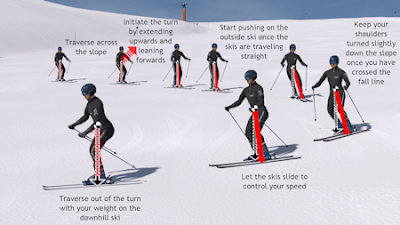
If I want to learn to ski, then of course I can learn to ski by skiing. 

That's totally unrelated to if I don'' want to be a murderer, I can become one against my will by having a PC be a murderer in a pantomime imaginary world of an RPG. 

Those are not connected concepts. 

"Learning by doing" requires someone wants to acquire a skill and so does by actually doing it. 

Your thesis is that someone doesn't want to acquire something that's not even a skill it's a personality trait and somehow acquires it by pretending to have it.


Bec:

Well, that applies heavily to a physical skill. 

Like skiing does not translate to racism, the actions associated are very different, one can be learned and reinforced in the abstract or without physical reinforcement.


Zak:


Yeah they're unrelated that's why your argument makes no sense.

Learning a skill and aacquiring a negative personality trait are not related.

"Learning by doing" is about acquiring a skill. 

So:

Do you have any science showing that someone doing bad things in RPGs leads them to do them in real life? Because without it you are literally repeating the Satanic Panic reasoning all over again. 


Bec:

The satanic panic was not just about rpg, or even at it's core about rpg

Rpg was just a affected thing.


Zak:

Please answer the question you were asked.


Bec:

Trying, but in doing that I have to isolate some things

Yoon, Gunwoo

Vargas, Patrick 

Know Thy Avatar: The Unintended Effect of Virtual-Self Representation on Behavior


Mostly it has to do with the persona involvement or identifying with what they are playing as.


Zak:


Link?


Bec:


https://www.researchgate.net/publication/260117599_Know_Thy_Avatar_The_Unintended_Effect_of_Virtual-Self_Representation_on_Behavior


Zak:


I will read it if necessary, but first: can you summarize the claim the paper makes?


Bec:


Essentially, the participants were more likely to exaggerate or react differently to tasks depending on how long they roleplayed, what they roleplayed as, or how involved or how strongly they identified with their persona given


Zak:


(reads paper--people play either Voldemort or Superman and then are given a test about whether to give a stranger chocolate or chili sauce)

They played for 5 minutes. 

I wouldn't call this a conclusive test especially in the face of the overwhelming research showing (for example) violence in video games does not translate to real-world violence. 

Also, the test of "Good vs evil" was whether they'd give someone chocolate (rated "good" BUT has sugar in it) or chili sauce (rated "bad" but it's not crossing any ethical lines to give someone chili sauce).


Bec:

Of course

Trials like this are very short.


So the effect from roleplaying for a extended period would potentially affect things much more.


And with video games, you have much less agency

It wasn't just the chocolate or chili, but also the amounts.


Zak:

So do you have science which backs up your causual claim not some other causal claim?


Also fwiw, Voldemort is a stupid character invented by a transphobe and if a scientist made me play them in a game I'd be in a bad mood, so this test might not be testing whether I am playing  a good or bad character but whether I am having fun or not and so put in a generous mood or not.


In an RPG, players are generally doing what they want and games where you're Superman are far more common than Voldemort, so it may be just rediscovering that people would rather play Superman than Voldemort.


Bec:

Well, closely related is the use of roleplaying in psychotherapy

Which is well documented

It stands to reason that if used to induce or allow behaviors that are not therapeutic, or reinforcement of behaviors. it could be bad


Zak:

No "it stands to reason". I asked for proof.

So do you have science which backs up your causual claim not some other causal claim?


Bec:

Also, Superman is patriotic and white and male lots of other things, both are very polarizing characters

So I agree that their choice of character could affect things


Zak:

All bad ideas AND good ideas start with someone saying "it stands to reason". What we need is proof of your claim. 

So do you have science which backs up your causual claim not some other causal claim?


Bec:

https://scholar.google.com/scholar?hl=en&as_sdt=0%2C44&q=roleplaying+in+psychotherapy&oq=roleplaying+

(this is just the results of a google search calling up lots of papers with titles) 

These in aggregate point to roleplaying having an effect on behavior

Zak: 

No. 

You're trying to prove a specific point:

Roleplaying by doing bad things can cause people to do bad things irl/ 

Not a much easier, simpler point that everyone knows: 

Acting out skills you want to have, that you accept are ethically fine to do and that everyone involved thinks you should learn to have can help you learn them. 

I said this already: you are not being asked to prove the obvious, well-known, uncontroversial idea that games can help people learn.  

You are being asked to prove the controversial pseudoscientific claim that games can measurably change your personality for the worse by having your avatar perform bad actions.  

Please address that, not some unrelated thing.


Bec:


That idea has a reverse, the concept that you can learn through roleplaying means that it is obvious people could learn or adopt poor behavior if it is accepted and not challenged  

Which can happen


Zak:


A skill is not personality trait nor is it the "opposite" of a personality trait. 

Those are different things.


Bec:


Agreed.


Zak:


So you're not making any sense


You are being asked to prove the controversial pseudoscientific claim that games can measurably change your personality for the worse by having your avatar perform bad actions. 


Please address that, not some unrelated thing.


Bec:


I think it is possible I am biased on this front. 

I have had many experiences where people perceived no moral limits in an RPG, and did things they would never do in real life in the guise of a RPG. 

The better I have grown to know these people, the more I have grown to think that their actions, however unhinged, seem to be a reflection of them, and not just a little


So maybe I should say that people's underlying personality or nature comes out when roleplaying. 

I think I have it wrong that roleplaying causes it, it makes it evident

Zak:


Ok, sounds like we're done.


I'm sorry you went through that, btw.


Anything to add?


Bec:


No, just thanks for not relenting. 

I get very Oppositional defiant disorder. 

So do we agree that people's nature comes out when roleplaying? 

If we do, I think that is much more interesting anyways.


Zak:


I think that's true, but often not in an easily reducible way. 

Like, example: I know a lot of gamers in the OSR (Patrick, Scrap, etc) who would kind of let other people take over in the game and wouldn't voice their opinion about the overall direction of what the party got up to. If they had fun--great! If they didn't--they would blame the people they let make their decisions for them. They would rather do something they didn't like then complain than risk being the leader and thus being seen as being as responsible as they actually are. 

Their play revealed something about themselves but not in a way you'd be able to predict at the time.


Bec:


Hmm

I have seen this too


Anyways, I agree that we are done

My original statement holds no water


Thanks for your time!


Zak:


A pleasure, Bec.


Wednesday, February 9, 2022

Goons on Trial (Part 1)

There is a poll at the end of this entry, please comment if you're interested.

Three Years of Lawsuits

Three years in. One thing I do is depositions, they work like this:


Wake up before dawn, shave, put on the jacket and button-down shirt and shorts, like a day at an office, fold out one of those changing screens to block out a covid-era apartment full of unwashed dishes, turn on Zoom, work the camera so only the screen is in the frame behind you, and wait.


My lawyer pops up on the screen. Theoretically, someone in their position could ask “Are you ok? Do you have any questions?” but there aren’t ever any. All of this is easy, there are never any surprises.


The various opposition lawyers—no matter who they are or who hired them—sweat a lot—as if not used to talking to strangers. Some, despite being very well-paid, use those digital backgrounds, like a wall of law books, overlapping their bald heads when they move too fast. Some come in at angles, as if turning on their camera for the first time.


I try hard not to be hard on them: their clients have given them nothing to work with. The evidence and witnesses prove I’m telling the truth, so they have to work another angle. They are desperate to find me lying about anything. 


Most of what happens in these legal cases does not go like in the movies, but these parts always do:

“How many people read that blog entry?”

“I don’t know.”

“That’s not what you said in March! You said there were metrics and you gave a figure, Mr Smith!”


(You can see them leaning in here, riding hard.)


“Yeah that was spring, this is like winter, I haven’t looked at it since. You could just look at what I said then?”

They pause.


I’ve seen these kind of lawyers’ notes, they are lists of groups of questions. You can see, in the zoom window, the lawyer re-orienting, making a shoulder movement to cross out what’s become a cul-de-sac of questions, scanning down for some questions not made irrelevant by this totally normal answer.


They have nothing. They need to have something. So, often surprisingly early, they get in to The Goon Questions.


Something Awful Slash Tee Gee


If you already know all about Something Awful /tg is and its shitty impact on tabletop games you can skip to the last section. If not: 


“Goon” is what people who hang out on a very old website called Something Awful call themselves. It pre-dates-, spawned-, and is almost-indistinguishable from-, 4chan. It was founded by a now-dead disgraced abuser and troll named Lowtax who you can google, and “Goon” means someone who was so excited to be a troll and spend time with other trolls that they paid him an annual membership fee. 


In the porn world, it’s also slang meaning “endless masturbation”.


The goon forums are topically arranged, there’s one for each thing goons are interested in, so:

  • video games 
  • presumably some other shit idk I never looked, 
  • and, of course, tabletop RPGs.

Since for the last two decades there have been dozens, maybe hundreds, of other places to talk about tabletop RPGs, the only reason to go there is to say trolly things that would get you tossed off any other forum. Or to hang out with other trolls.


The wildest thing about goons is they all act the same, even when not on the site, even when on private blogs or twitter, under their real names:

  • Cartoon and video game avatars
  • Most-online-possible vocabulary, verbal tics, topics of conversation
  • Obsessively comment on whatever’s topical on twitter that day
  • Almost never, even when not on the site—on twitter or on a discord--talk about anything that happened to them that wasn’t on a computer
  • …except on rare occasions, and then only to frame it as a great injustice, like they went to 7-Eleven to buy Cheetos and it was a great injustice
  • All this is so consistent it’s weird

The tabletop-specific troll forum was called /tg, short for “traditional games”. Since tabletop games (especially when it started) were not mostly a thing to be done online, they all developed creepily similar takes:

  • They played D&D and it was a great injustice
  • The solution was 4th Edition D&D because 4e was not the earlier editions that had made them cry
  • Anyone who played a different edition was a “grog”—meaning they were secretly a member of the GOP no matter what they did
  • So like if it turned out Bernie Sanders played old-school D&D then Bernie Sanders is a “grog” and a secret member of the Republican party
  • If you look at the /tg threads from 2009 to around 2015 this is, again, so consistent it’s weird

Why did they troll so hard for 4e rather than, like the rest of the RPG industry, troll indiscriminately? My guess is just that it was the edition-wars era and that whoever ended up being so online they got to be the moderators of /tg just kicked out everyone who didn’t troll 4e-ward.


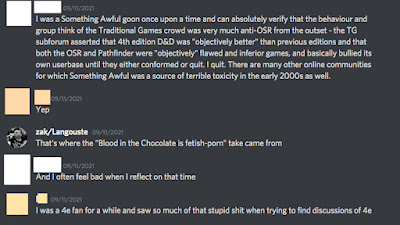
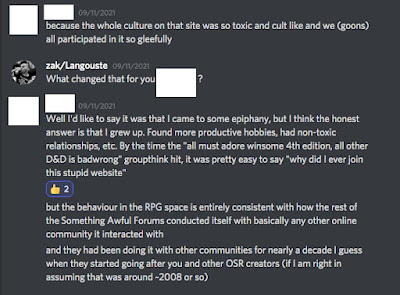
Here’s a reformed goon. I think everyone in the screencapped conversation reads this blog so if you have any questions you can ask them in the comments:


I first found out about the goons around then because it was one of a thousand sites making fun of my ex for being a girl in porn yet not being like them while doing it. Specifically: they were attacking her for having extension cords on her wish list and playing old D&D instead of new D&D. I rolled my eyes at the existence of what appeared to be another nest of frat bros and moved on, I didn't interact with anyone from there until years later.

Once the 5th edition of D&D had been out for a while and been popular and the Old School gamers had started winning awards and fans for their stuff, the goons softened on the "only 4e is good" line. They went on to mostly championing other indie RPGs. But:
  • None of the people who had spent all that time harassing anyone for playing anything besides their favorite edition of D&D admitted they were wrong
  • None of the people who changed their tune apologized to their victims
  • None of them did anything to help their victims
  • None of the people who had positions of influence (moderators, game designers who hired people) where they did that ever suffered any consequences
  • Even with their new and more catholic taste, they were all still assholes and acted the same

The Goon Questions

Earlier I said the wildest thing about goons is they all act the same. The wildest things about goons in the tabletop hobby specifically are:
  • Despite how much impact they've had, nobody talks about goons (in many cases, explicitly because they're afraid of being harassed).
  • When someone reveals they are a goon, the reaction from everyone else in games isn't Oh wow, you're a troll and just admitted it? We can't trust anything you say please stop posting your weird accusations until you get therapy and work to undo the harm you did.
This consistently blows my mind and has for over a decade--they're a textbook example of "abusers you shouldn't let into your community". If someone can explain it in the comments, please do leave one.

Some examples:
  • Goons get positions of influence: goons worked on the Lancer RPG, goons moderated RPGnet, Evil Hat Productions actually actively went to Something Awful to recruit goons on the site, Chris McDowall, an OSR blogger and someone who, therefore, was a de facto victim of various goons for years--let them on the OSR discord once they decided they liked OSR games, goon Dan Olson, aka "Folding Ideas" has a popular YouTube channel and people actually watch it.
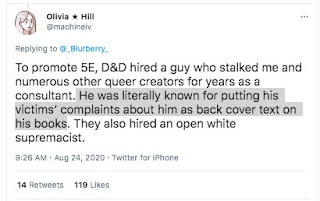
  • Goon conspiracy theories are repeated on RPG twitter even by people way too snobby or "professional" to be goons, including basically everyone who participated in the harassment campaign against me
  • ...and their lawyers
Now, the goons themselves are trolls who make shit up--that's their whole deal. I sued the main troll from Something Awful /tg --Paul Matijevic aka "Ettin"--and he folded almost immediately. And it wasn't as if he couldn't afford to defend himself since he proved he could quickly run a fundraiser for legal bills.

This was the dude who had been more aggressively accusing me of "abuse" and screencapping me than anyone else online. He could have defended himself successfully by proving any kind of abuse and when his bluff got called he gave up almost as soon as he hired a lawyer. At this point anyone who had ever accused me of abuse--at least online--should logically have to go "Well Ettin had recorded Zak harder than anyone, since he was lying about all of it, there isn't anything else" but, as noted up at the top, the other peoples' lawyers don't have anything else to go on.

This means, apparently:
  • There are people who keep paying lawyers hundreds of dollars hourly to then tell their junior partners, paralegals, and research assistants to go on twitter and discord and search "Zak S""Bad".
  • These folks turn up goon conspiracy theories from either goons or in the mouths of useful idiots who can be relied upon to repeat goon shit uncritically.
  • They then contact the people who post them, who either don't respond, admit they have no idea where they heard them, or trace them back to goons like Freyja Erlings, Kai Tave, and Nora Reed.
  • The goons themselves, when contacted, either don't respond or admit they have no evidence to back these up.
  • The lawyers go "Well fuck!" and figure they'll somehow catch me out by asking about them anyway, which leads to exchanges like...
"Is it true, Mr Smith, that you got names of people who complained about you from one Mike Mearls, head of Dungeons and Dragons, and proceeded to harass those people online?"

"No."

At which point I remind them they're welcome to all my communications with Mike Mearls because of the legal thing called "discovery" which I did months ago and was explained in My Cousin Vinnie plus they have my permission to contact my phone provider to verify we had no phone conversations at the time and they can ask Mike--who doesn't like me at all because I sued him--and he can verify we didn't meet ever until years later.

And then they pause and sweat and cross a bunch of stuff out and go "So you've been banned from theRPGsite, is that true?"

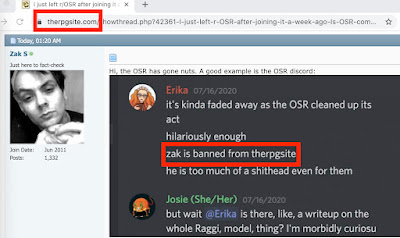
And I go "No, but a goon said that and I posted on theRPGsite immediately after"

And they go "What's a 'goon'?"

And it goes on and on for hours: a goon said I was a Nazi so I have to remind them I'm Jewish and got put in the paddy wagon for being at a Black Lives Matter protest, a new goon says because I'm Jewish my family's rich so the lawyers spend hours chasing down documents proving nope I make exactly as much as most other painters lucky enough to show in Chelsea, a goon says I'm actually a parrot named Eugene so... etc.

This is all done under oath and using their client's billable hours, also eating massively into the court-ordered limited amount of time they have to question me.

Basically, the point being: for every dollar a goon has thrown at my harassers, they've cost them hundreds or thousands of dollars by mistakenly creating the impression that what they said was reality-based, thus basically trolling their side's own lawyers.


So, Over To You

In the next entry I am going to go into some detail about goons and what I learned about them during the legal process, et cetera.

However, one thing I noted earlier is it's weird that nobody in tabletop talks about Something Awful. Maybe that's changed now that the rest of the internet has started to realize the place was an abusive shitbox because the founder killed himself, I don't know. So I don't know how much any of you care.

If you don't care, don't comment, and I'll just post the short version when I get around to it.

If you do care and want to hear more about what I know about specific goons and the specific trouble they caused, including Freyja Erlings, Ettin's best pal, Kai Tave, the one-goon edition war, Nora Reed, the goon who built harassment robots, Nickoten, the goon who goons all over the OSR, Erika Muse, the goon who straight-up admitted she is full of shit and many more, then leave a comment saying "Give us the details" or something like that.

If I get 100 comments saying people want all the details, then I'll put up the long version.

No anonymous comments allowed, use a persistent identity.


Thursday, February 3, 2022

REAL D&D!

Continuing the Disagree-A-Thon, today we have Matthew, who wants to disagree about what D&D even is...

So Matthew said:

"Fans of modern D&D (3e+) don't actually want or even like D&D - they just want a generic fantasy game to play make believe with."

And I said:


So the first question is: how would you define "D&D"?


M:


For me, D&D is a specific game where adventurers go into dangerous places to earn riches and power in a largely indifferent (or perhaps slightly malicious) world.


Z:


And do you think of that as "Matthew's version of D&D" or do you feel that definition has some rational claim to be The D&D?


M:


I don't think of it as Matthew's version of D&D. Matthew's "D&D", or more realistically, Fantasy Roleplaying Game, when I started, quickly developed generous sets of ability scores, multi-classed humans, paladin/ranger/magic-users, shadow flame ninjas, muppets, +8 weapons, chocobos, and narratives. There wasn't a huge chance component in what you would find or encounter unlike D&D by its written rules. Looking back, for me, to say it was D&D was more dishonest than my friend's Rifts game where you can play a Timelord or Amberite in Phase World but at least you're still playing in the greater Rifts setting and not ignoring systems. Meanwhile, D&D itself has a specificity. The world is humancentric. There are limitations to what PCs can do and PCs have to scrape by and weather the storm of fortune to obtain the game's objectives - treasure and power. The worlds D&D emulated in prior editions had this rigid foundation to build upon which more than a handful of people wanted to toss out. I hope this makes sense.


Z:


It all makes sense but it doesn't answer my question:


"do you feel that definition has some rational claim to be The D&D?"


What makes one definition of D&D special, primary, "more real" etc?


M:

Yes. I think the definition (D&D is a specific game where adventurers go into dangerous places to earn riches and power in a largely indifferent (or perhaps slightly malicious) world) I originally proffered has a rational claim more than just my preference. The rules laid in the earlier books support this. Throughout the '80s and '90s, I would always run into people either amending the rules OR adhering to the rules but no one questioned that level limits, class restrictions, random encounter tables, and level draining undead were D&D, they just claimed it was unfair or at best arbitrary. Now, experience rewards in 2E muddies this by making treasure experience optional and replacing it with story awards but that just undermined how the game was meant to be played and also highlights how the game was being shifted to suit people who wanted something else.


Z:


So, just to clarify and not argue (yet) your position is:


This is a "realer" definition of D&D because it is the definition the game had in its earliest incarnations.


Correct?


M:


Yes. I cannot argue against that.


Z:


Ok, so, I'd say two things:

  1. D&D as originally conceived seemed to me already two things, on day one. One was Gary and Dave saying "This is rules for making fantasy campaigns, I'm pretty open to you all adding things, I myself have taken a melting-pot approach to what's in the game, it's got some Tolkien, some Vance, other stuff,  whatever, do what you want" the other one was Gary and Dave running their own games with their friends and producing material that, consciously and unconsciously, had a narrower focus on a specific kind of desperate-adventurer play like what you decide, at least in the beginning. Early materials all show this dichotomy (like almost all RPGs) between "What this game is meant to enable" (a large canvas) and "What I think to do with it at home" (a smaller one).
  2. I don't see any linguistic advantage in using the phrase "D&D" or "real D&D" when you mean, more precisely "D&D as originally conceived". It takes longer to say, maybe, but it is more precise. For example: it condenses what took us 4 email exchanges to establish down into one phrase. Saying "Y'all aren't playing D&D as originally conceived" may not be as FUN as saying "Yall aren't playing D&D" but it explains to everyone listening what you're saying and that's kind of the point of language, right?

M:

Fair points all around. I should have been more specific. Are we still in disagreement about something?


Z:


I guess not.


Thanks for writing in!


M:


No problem. It was a pleasure!