Considering it started (1) as no more than a pretext to publish D&D adventures, James Raggi's Lamentations of the Flame Princess gets talked about an awful lot. This is probably because while the art still manages to provoke more conservative competitors in the indie RPG scene to dismiss it as an exercise in shock value, LotFP keeps showing a willingness to bankroll some of the most out-there content in DIY RPGing, including stuff from Kenneth Hite, Vincent Baker, Patrick Stuart, Geoffrey McKinney, Jeff Rients, Scrap Princess, Kelvin Green and Zzarchov Kowalski (also: me) all under the pretext of making weird-horror adventures set in the age of exploration.
So, at the risk of going all late-era-White-Dwarf, I've decided to interview one of my own publishers...

LotFP puts out two kinds of products--supplements for the default 1600s setting, and books like Vornheim and Carcosa which are kind of their own worlds. Why is that?
The 1600s Real World Earth idea just kind of happened along the way. It wasn't an intentional plan, and originally I thought it was incompatible with the game. But then I made the decision to jettison the original setting I'd been using since 1990 or thereabouts and go Real World Earth and it fits wonderfully.
There are a lot of assumptions one makes when gaming, and people really don't go for the "Medieval" part of standard fantasy while at the same time having tons of medieval trappings in their games. It just made sense to bring the game-world closer in line to the assumptions most people make when setting up and playing these games. 1600s Europe is post-Reformation, post-DaVinci, at least a Galilean understanding of the heavens, there are still kings and queens and swords but also parliaments and capitalism and if you mean France then you can just bloody well say France instead of inventing fantasyland Parisia.
This also works well for releasing things for use by other people, because often their settings are Hyborian-style mishmashes and approximations of real-world societies, so if I say "France" that's easy to translate to their home setting than trying to translate my fictional mishmash Frankland to their different kind of mishmash Parisia.

This also helps establish LotFP stuff as distinct from everyone else, because a lot of D&D "content" is rather incompatible with a historical setting, so it's that much easier to get rid of orcs and beholders and not use elves and suddenly LotFP stuff still works with, but isn't interchangeable with, other games. It has its own identity which is absolutely crucial to establish when there are over a hundred "clone" games out there which in some quarters have the reputation of being mere cut-and-paste chicanery anyway.
It's a gradual thing though, as you get "legacy" releases like Vornheim which came about before the switch so it's full of elves and dwarfs and some of my old adventures have that stuff and there's Qelong which is clearly inspired by something real-world but it's obviously not...
Things like Carcosa and A Red & Pleasant Land, those still work because they are "someplace else." I can run 1625 England with Carcosa existing as-is and who cares? It's so many light-years away. For Red & Pleasant Land I just ignore the "Quiet Side" details and just say it's my world, as-is, on the other side of the looking glass. Easy.
It gets a little more difficult when people are still sending me stuff with "D&D" content though. I hope I'm not talking out of turn but it's a current concern and so the perfect example: Veins of the Earth (2) is a brilliant, original vision of the interior of the Earth with a lot of emphasis on just how alien and strange it is down there. But it came to me with a whole lot of Greyhawk-legacy stuff in it. References to gnolls and orcs and a not-so-disguised version of the drow, things like that. But if you wipe that all out, keeping just the original creations (and maybe keeping adaptations of less-known, certainly not iconic ideas), you have a work that is much more powerful as its own creation, and also something that works even better in a wider variety of campaigns easier. It'll fit, as-is, with no tinkering necessary, equally well within a historical Earth setting or Greyhawk or the Warhammer world or Dark Sun or whatever world you've made up for your own use.
I've got enough on my plate that I can now be quite picky about picking new projects that don't use Tolkien or Greyhawk setting elements, and either fit in with the historical Earth setting, or at the very least don't work against it, and if you think that's a silly attitude to take, you luckily have a million billion other people publishing stuff that might be more to your taste.

For the slow learners--why did you originally design the LotFP game to be so much like old editions of D&D?
It was just a continuation of what I played. If I was a hardcore Traveller player, LotFP would be a 2d6 system with lifepath character generation, and if I was a hardcore Runequest player, LotFP would be BRP. It just so happens that I started with D&D and of course there'd be periods where I played other games, but it always came back to D&D. There's something about the simplicity of the stat blocks and the entire process of play that works for me, so why not just go with that?
But that's just the core mechanics, and as time goes on it's drifting further and further away from baseline understood D&D concepts. People for some reason treat the rulebook as "the game" rather than the adventures and supplements (which to me is the real content), so the next printing of the Rules & Magic book will be making some important changes (getting rid of demihumans and Clerics as things in LotFP, for starters) to make it clear to people and further establish LotFP as having its own identity.
Would it basically be fair to say LotFP was published as a game in order to make it easier to make and sell adventures--which were your real interest at the time?
That was indeed the case, yes. My goals of market penetration and profiting from it were a bit hampered by releasing only supplementary material for games not necessarily being promoted as much as they could.
Of course once I decided to do it, it becomes a real project and not just something to just fart out as quickly as possible. And every few years I need to do a new printing and LotFP is a living game so it's time to go to work again instead of just reprinting.

Although LotFP is still very similar to it's D&D roots, most of your actual rules modifications seem like they've been well-received and sometimes picked up in more mainstream products. (3) Were these things you thought up while writing the original edition or imports from your home game?
Rules modifications are first conceived of when writing for publication, and then those new rules are introduced in play to see if they work or to figure out how they need to be changed before going to press. Before the first edition of LotFP I used Labyrinth Lord and Basic Fantasy RPG (depending on timeframe) by-the-book, as I recall. When I ran AD&D 1e starting in 2006, the intent was to go by-the-book, but fuck me, I don't think that's possible with 1e so it ended up being mostly "Basic rules with AD&D ornaments" (races, classes, spells, that sort of thing).

Early in the whole DIY D&D scene, you published a stupid, hyperbolic essay called "I hate fun"-- this pissed off people off--mostly stupid people, but still, people. Considering how much fun we've all had playing LotFP modules in the past 5 years or so, have you changed your stance on fun?
Fun still sucks.
It's just the view of gaming as doing all this stuff that's so grand. Be anyone! Do amazing things! Save the day! Isn't this all so cool!
Well, no, actually, it isn't.
The physical laws of the universe break every time some beardy guy in a robe wiggles his fingers? That weird looking animal over there is smarter than you are and also breaks the laws of physics AND it wants to murder the fuck out of you? You're seeking that shit out? Jesus Christ that's not a setup for feeling cool and doing awesome things, that's a total horror show. That would be like realizing you're in Nightmare on Elm Street movie and deciding to take a handful of Xanax to go visit Mr. Dream-Dude. What idiot would ever do that?
And if you actually survive doing this and become successful in killing all sorts of bizarre threats, you're not Big Cool Hero, you're somewhere between Rambo (from the first movie, when even the most unaware couldn't pretend he's awesome action hero) and that guy that shot the lion. You're all fucked up in the head.
So anything that increases the COOOOOLLLL AAAWWEEESSOOOMMMEEEE EEMMPPOOOWWWERRRMMEENNTTT features of gaming just don't agree with me, and that's what Leading Brand Role-Playing Games push as fun, so I hate Leading Brand Fun. ("I Hate Leading Brand Fun" isn't so catchy a title though.) I prefer presenting things that highlight the hell that this sort of adventuring would really be, not as a form of criticism of the more cheery game styles, but because to me the decisions characters make in horror movies are more interesting to see and think about than the decisions characters make in action movies.
Of course when I run games, the more fucked-up and gross and totally screwed things are in-game, the more everyone around the table is laughing. I'm a total failure.
(Now, things that are actually fun and cool in real life make for horrible gaming. "Get laid a lot and between orgasms go golfing or rock-climbing or knit or watch Seinfeld or whatever it is you like to do!" isn't something you want to sit around pretending to do, you want to actually do it. Or, since gaming is so cool, you could play a game where your characters are playing a role-playing game, because then you'd be doing it AND pretending to do it AT THE SAME TIME.)
So when you say "I hate fun" did you really mean more "I hate wish-fulfillment in games"?
It's not that I hate wish-fulfillment in games as a concept, I just hate it as a default assumption. If people play wish-fulfillment D&D, I don't care, but if a rulebook is pushing the idea that the whole game is to make everyone feel awesome and special, I gag, and if that seems to be the industry standard across major game lines, it's time to go to war.

When your players go "that was fun" do you just look away, toward the horizon?
Nah, I just realize I need to kick it into overdrive and create such hell the next session that nobody would dare tell me they had any fun! (4)
LotFP has been pretty successful compared to the average cottage old school RPG publisher--why do you think that is?
It had to be. I made it clear up front that my goal was to live off of doing this. That's a hell of a thing to have said before releasing the first official product in our little (not so little now) space of the gaming scene in 2009, especially since that first adventure was pretty much print-on-demand, printed on the home laser printer and then bound and trimmed by hand.
Another thing I've done is look at how professional companies treat their products and bring them to market and emulate them, and not use the small press/part-timers as a business model. Make the books look as good as possible, provide lots of 'support' material like adventures and settings, get them into wider distribution networks so you can get the books in front of people instead of the people always needing to come to you, and not being afraid to say I WANT YOUR FUCKING MONEY.
Also the fact that my releases aren't connected in any way allows people to jump in at any time. It's not a unified game line requiring mass purchases to be able to make sense of it all. Whatever book looks cool to you, you don't need to have any of the other books (except maybe a rulebook, not even necessarily my rulebook) to use it to the fullest.
These days I think the success is due to the fact that people know that whatever LotFP releases, it'll be something wild and different and probably in some ways irresponsible, but at the same the catalog has generally been pretty strong so there's the expectation that it'll also be pretty good.

Are Frog God, Sine Nomine and LotFP serving three separate, overlapping niches or is the market of DIY D&D stuff just expanding period?
My impression is that Frog God is concentrating on Pathfinder these days and their Swords & Wizardry releases are simply adaptations of the things they were already doing for Pathfinder. Maybe I'm just out of the loop but if I'm that wrong it does mean the OSR scene really is that much bigger and disparate than I thought, which would be a good thing. It's not good to be a little incestuous bubble. Maybe when the next version of Swords & Wizardry (that's the one that's going to have the pastel cover with all the ponies, right?) (5) is ready things will shift a bit. We'll see.
Kevin Crawford is a workhorse. I really wish I could just bang out the wordcount that he does. It's intimidating as hell. It's funny though, the less I'm interested in one of his projects, the more impressed I am with it. I don't do domain games, but I think An Echo, Resounding is absolutely amazing in concept and execution. I don't do one-on-one gaming at all but Scarlet Heroes is an inspired work. I found Silent Legions rather dry and uninspiring, but no wonder, because that sort of thing is what I already do and I don't do it that way.
But my impression is that Stars Without Number is his most popular game (it keeps getting more supplements, that means something, yes?), and I don't hear a lot of about what people are doing with it, so that to me indicates a bigger scene for these types of games than one might initially assume. Either that or SWN purchasers are just collectors but that seems like an odd choice for collectors to swarm to.

People love to complain about your stupid sales gimmicks and say they'll backfire but they always work. What's up with that?
Gimmicks? Or good salesmanship?
Whatever gets people's attention, you know? I don't want to sit around waiting for people to discover LotFP. When I release something I want everybody to know about it. People selling stuff need to be less ashamed about the selling stuff part.
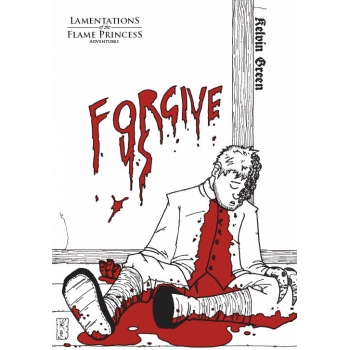
Your own modules have a distinctly Weird Tales vibe, with a grounding in alternate history. Do you feel more like a writer or publisher these days?
I feel like a publisher more these days just because my (latest) Magnum Opus, the damn Referee book, isn't finished yet and it's been in the works for ages and keeps growing in the middle and then I release a book by some guy who basically makes me drop everything to pack orders for a solid month and managing artists and other writers and reading a 400 page draft someone wrote and I'd rather just see a finished book but nobody else is going to do it right so it's all up to me now, isn't it?
Once the dam breaks on my projects and they're released people will once again think I'm a brilliant writer and I can swim through all the awards I'll get like Scrooge McDuck in his money bin.

The stuff you and Rafael Chandler have written has garnered a lot of criticism for its goregrind aesthetic, yet the same people seem to have no complaints about the same aesthetic when it's in horror movies or heavy metal videos. Are these conservative critics breathtakingly ignorant of the outside world or do they just stick to being freaked out by RPGs because they're scared of taking on media that millions of progressives and feminists enjoy and defend?
I think it's just easier for these people to avoid certain movies and certain types of music, but they're knee-deep in the RPG scene and here it is and they can't avoid it and they don't understand why anybody would do this sort of thing and they don't understand why anybody would enjoy this sort of thing and they've never had to really think about it because of how easily they could just avoid it in other media.
Their attitude is just a consequence of intellectual isolation with a gross intolerance of any taste contrary to their own. It could not possibly be an intentional effort to influence public opinion concerning the expression of imagination by people in a creative field for the purpose of disappearing any work they don't approve of, could it? Nah, nobody involved in gaming is that evil.
Gimme three overlooked LotFP releases that you didn't write and tell me what they're about.
Scenic Dunnsmouth. It's a village in a swamp that's under threat, but before the session begins you randomly generate the village and the threats and how severe the threats are. To me this thing is as groundbreaking procedurally as Vornheim. The random aspects to constructing the adventure can be adapted to so many more situations, and the way we set the book up so you can print out only those households that exist in your particular version of Dunnsmouth, and all that really creepy Jez art, this is really a first-class release that should have crossover appeal outside of our scene. (6)
The Idea from Space. Two competing factions of people under the control of alien entities (one physical, one cerebral) fighting it out on a small island. It's a stranger kind of Red Nails, and the Xaxus concept is just killer. I think this one gets overlooked a bit because it's so short and therefore loading it up with fancy production values didn't make sense and the author isn't super-active on everybody's friends list or circles or whatever. But it really is good.
Coming up with three is hard because I've been lucky in that pretty much everything else has either found an audience or is a smaller thing that wasn't expected to blow up big or anything so I wouldn't call them overlooked.
LotFP is about as "card-carrying OSR" as you can get, yet Kai Tave, an RPGnet moderator, claimed "card-carrying OSR" people all hate younger gamers because they don't understand THAC0. Yet LotFP (like most, if not all, OSR games) doesn't use THAC0 at all and LotFP products have been enthusiastically embraced by younger gamers --including ones barely old enough to read. What's wrong with Kai Tave? Dropped headfirst on the floor as a child or something else?
If I'm being charitable, I could say he's just grasping for any straw that would give some sort of appearance of objectivity when it's just a matter of "I don't like this." In the same way I don't like a band and I feel the need to articulate it beyond "I don't like this" and I'll come up with any reason to "objectively" prove that a band sucks. "Oh god, look at the shoes they're wearing in their promo photo, it's a clear sign this band just doesn't care about what they're doing at all!" mmhmm.
If I'm being uncharitable, I'd say he's just a stupid cunt.
Oh great, you called someone a cunt. I can see the bloglines now, "Raggi uses misogynist slur!". Is there someone you'd like to call a dick so we can even out?
Nobody cares about being called a dick. It's general-audiences advice, "Don't be a dick." It's so toothless that calling Superman a dick is now some sort of internet in-joke. I think being called a jerk is more hurtful at this point than being called a dick.
Cunt is pretty much the last general-use insult that makes anybody gasp anymore. People forget that you used to have to pay to hear any swearing in media, and now it's everywhere and now all these shits and fucks are basically punctuation instead of anything powerful.
Cunt still has the power that proper swearing used to have, and minimizing its impact by trying to "even it out" with penis-word insults which don't have any power behind them at all just sells it short.
If people want to make a big deal of it, that's fine, it helps the word retain its power. If they want to pretend it's an insult to women, they can, but it's just as wrong as pretending that calling someone a dick is an insult to men. The insult is to Kai Tave. He's the one being degraded because he's the stupid cunt. Women in general are just fine.

Regarding your at-home group: are they guinea pigs for these LotFP adventures? Do they die like flies?
Of course they're guinea pigs. Things have to be played before they're published and that's the most convenient group of test subjects. They don't die like flies though. When pretty much every adventure is a Raggi adventure, you start thinking differently. Some might say you go mad. But it's the kind of mad that helps you survive because you know you're in hell and not in any sort of sane, kind world.
What is the make-up of your home group--men, women, young, old? I heard you had a Finnish porn star in your group, too.
I haven't played for a bit while I've been getting some things squared away, but there was a core group of four, one woman, all quite younger than me (one very much so), with a revolving door of guest players. When I get back things into gear I'll be doing a fresh recruiting drive because I like a regular group of at least six (in Vaasa I had more than that every week!) and we'll see who shows up. I haven't done a from-scratch player recruitment for four years or so.
The porn star was in the group years ago, she's since moved away.
Other than LotFP stuff and people who've written for LotFP, whose work is impressing you in the RPG scene?
That's tough, since if I like what I see I try to hire a person. My RPG purchases are full of Chandler and Zzarchov and Patrick & Scrap and Hite. I'm really just as likely to back a Kickstarter from someone I've never heard of that seems like they have an interesting idea as I am buying something from someone whose name I recognize.
Of the LotFP adventures, what percentage do you think fall solidly into "screw the players" territory?
Only Fuck For Satan, but if you get an adventure called Fuck For Satan expecting everything to be above board, then I'll probably enjoy the following blog post about how all your players died quickly for no reason.

Death Frost Doom (7) was your first relatively large success--do you think it was different than the later adventures you wrote in any important ways?
I'd like to think that all the adventures I write are different from the others in important ways. But Death Frost Doom was the first look anybody really had at Full Frontal Raggi and my focus of Dungeon As Hostile Hellhole. That the atmosphere called for more serious oppressive tone and less of me having a bit of fun in places or dealing with crazy time/space effects and all that probably helped.
What are some interesting historical eras nobody's done much with in RPGs?
It's not any specific time period that's lacking, it's variety within the time periods. There are lots of Western RPGs, so you can say the late 1800s is an era that's been covered a lot in RPGs...but there isn't a lot of variety. Why not late 1800s Africa and go all Heart of Darkness or concentrate on the British Raj?

You do all this yourself--have you considered hiring a full-time employee?
My yearly actual pre-tax take-home pay is barely into five figures (so much would-be profit instead goes to making the next books even more awesome and unsold stock is counted as an "asset" for tax purposes) and my "office" is the corner of the living room and so much of this two-room apartment looks like a warehouse. My "success" is relative - the year before LotFP opened as a business the only place I had to sleep was somebody's floor. Now I can afford to spend a couple hundred euros to travel for a weekend and catch a band and stay in a decent hotel every once in awhile while living in an apartment in a nice part of town sleeping in a real bed I paid half for in an apartment I'm paying my share of rent for. The next big upgrade will be getting an apartment with an extra room I can use as a dedicated office/storage area, which will help productivity, because when the wife is home and hanging about (and she has an irregular work schedule) I'm not exactly in a writing or editing frame of mind.
Even if the money was available, hiring an actual employee in Finland is a hugely daunting idea (I'm scared shitless of the labor laws here, very strong compared to Georgia, my primary US residence as an adult and what I'm used to..."at-will" employment sure looks better when you're a small business owner than when you're a schlub employee, let me tell you) and I can't think of any gamer whose face I'd want to see on a daily basis anyway and if they're not a gamer what exactly am I going to pay them to do? The logistics (legal and "are you working on outside commissions on my dime?") of hiring someone long-distance on a full-time basis are way beyond my meager business knowledge.

What's coming up and in what order?
Oh bloody hell, I don't know. LotFP releases seem to be stuck in time vortexes. Vortices? Beyond the Vornheim reprint (8), the order is a complete crapshoot.
Broodmother Sky Fortress (Jeff Rients of the Gameblog with MacLean art), Towers Two (Brockie (9) /Bittman with Jeremy Duncan art), World of the Lost (Rafael Chandler with Benedict art), and England Upturn'd (Barry Blatt with Richardson art) are just waiting for art to be completed and inserted into layout and they would be done.
I'm working on the Ref book and the next Rules & Magic printing and once those are done I can finish up my next adventure Covered in Sick.
I guess Veins of the Earth (Patrick Stuart with Scrap Princess art) is the next thing closest to having final writing in, and then that can move to layout.
Other major projects (not counting shorter-form adventures) in the works include the second edition of Cursed Chateau (Maliszewski), The Shadows Lengthen in Carcosa (McKinney), The Combing of Hairy Nook (Keigh - I have text on this but waiting for his shorter adventure to get done first so I can see how people react to his style and see if there should be greater editorial input for the longer form adventure), Strange Distant Strand (Curtis), the Viking Amazon thing (YOU!), William Shakespeare's The King in Yellow (Dorward), plus there are a couple of historical sourcebooks and an undersea supplement that I don't think have had any ground broken on them so best leave them unnamed right now.
I'm sure I've forgotten something and am about to get angry emails about someone's project laying fallow.

Certain things get bottlenecked and we're in a stretch where nothing has been released for nine months now and it looks like I've taken on "too much" but... well, if people hit their deadlines then it would look like a well-oiled machine and things wouldn't be all bunched up, but when they don't hit their deadlines, what do I do? Dump 'em and start over from scratch (delays) or just keep on with the people that were my first choice to do the awesome job (delays)? That's the part of being publisher I hate the most...
Truth is, good stuff doesn't get shit out on demand or to a set schedule. We can accept that truth while aiming for elite and superior work (and occasionally even succeed in achieving it in a final product) or we can settle for an on-time and workmanlike assembly-line product.
I'm rather aim for the moon and miss it than aim at the ground and act pleased with myself that I hit it.
Footnotes:
(1) Like most old-school games.
(2) Scrap Princess and False Patrick's spelunking neo-underdark nightmare, currently in the works.
(3) 5th edition D&D f'rinstance.
(4) For the record, I like fun and hate wish-fulfillment fantasies, but it's not my interview.
(5) This is a joke about how the next S&W edition being put together by our pal Stacy Dellorfano's all-female team .
(6) Useful discussion of Scenic Dunnsmouth here--if you can't read it, write to me and ask to join my Google+ RPG circles.
(7) The first edition, before I got involved with it.
(8) This happened between when the interview was recorded and now.
(9) That is, the late Dave Brockie--of Gwar.