As has been pointed out once or twice around here, while in LA I play a slimmed-down version of 3.5 rather than my beloved AD&D.
One of the bugs/features of 3.5 is a more rapid level advancement than is right and proper, I mean, um, than I'm used to...
Anyway, one of the nice things about this is it allows me to sort of imagine a campaign where my players might actually one day be able to start out at level one and move up to fighting on the crazy high-end of the game and try to fight Orcus and whatnot sometime before the group all breaks up and moves to different places or has kids or gets new jobs or is drafted or whatever.
Which, no doubt, was one of the original intentions of that feature of the game so duh.
Anyway, I have a relatively stable group now, with 2 second-level players and one 4th level player and I am beginning to dream long-term gonzo sandbox dreams.
Since most of the players have never played in a long-term campaign before and all of this is new to them, there's no reason not to use a ton of classic materials. They don't know who Acecerak is.
So, a few considerations...
-This has got me all excited about The City-State of The Invincible Overlord. The original version--it'd be pointless to run it for my group without all the politically-incorrect '70s rules for women.
-Killable gods. It's going to happen. One day. (At some point after they all learn what "AC" and "HP" stand for, presumably.)
-The Tomb of Horrors is going on the map, somewhere... Again: the original. However, this is tricky--it's a module that demands that your players be operating at a very high level, not just their characters. We'll see if that ever happens. Has the original been re-printed?
-Vault of the Drow. Oh, so you're a Dark Elf? Meet the family.
-Cities. I like a nice big pre-packaged, detailed city module that I can take a razor to. I like knowing no matter what building the PCs go into, there's something there. So far we got the Vault and the City-State--can anybody think of any others? Let me know and I'll be grateful. It doesn't have to be old-school.
Friday, December 11, 2009



Thursday, December 10, 2009
Your Character Sheets Probably Don't Look Like This
 ...but mine do. Or they do now anyway.
This is because last week I had roughly the following conversation at least twice:
"Ok, a flaming axe shoots out of the wall at your head--what's your reflex save?"
"I don't know."
_____________
So instead, it will go more like this:
"Ok, a flaming axe shoots out of the wall at your head--give me your reflex save--that's the number in bright red 48-point type."
"It's +2."
"Fantastic, roll some dice."
Maybe this is overkill but yesterday I had this conversation with Kimberly Kane, aka Agent Scully in The Sex Files:
 Me: "I'm figuring you're gonna want to be a fighter, right? Something simple?"
"Uh, I guess, I mean, what are the choices?"
"Pretty much anything you want, really, take a look."
looklooklook
"So it's all medieval?"
"Uh...yeah."
"So there's no robots?"
"Not so much. Although...[oh let's not go there quite yet]...yeah, there's no robots."
"Oooh, what's that?"
"That's a beholder."
"Can I be that?"
"Ummm..."
Wednesday, December 9, 2009
Is My Map Working?

Here is the beginnings of a map. The idea is to convey the flavor of what goes on in the place by the way the font looks and the name sounds. My players won't know what to expect in each place, but their characters should have at least some recollection of the way things are in various places. So I'm testing it on you:
-One of the places is all heavy metal and shit.
-One of the places is all vikingish and cold and merciless.
-One of the places is creepy and Lovecraftian.
-One of the places is weird and Vancian.
-One of the places is old and gothic and M. John Harrisonish.
-One of them is just a minor city that happens to be on the map.
Let me know if it's working by telling me which subgenre you think goes with which name on the map.
Tuesday, December 8, 2009
Another Brick In The Wall, Pt. 2
Here are some things I learned/realized while testing out the Another Brick In The Wall method for making dungeons:
-Since half the cards include monsters or NPCs, the generated dungeons end up being very densely populated. Since the point of this variation on the W/O Walls method is to make a less funhousey, more thematically coherent dungeon, I recommend:
*Dreaming up some in-game reason, clear to the PCs, why the dungeon is full of things, or...
*Making many of the inhabitants just vermin that can be ignored unless the PCs want to do something specific in the room, or...
*Throwing some major arcana into the deck before laying down your cards, then saying they indicate a more-or-less empty room.
-It is a very good method for making dungeons with opposing factions that are hostile to each other.
-I fit the whole dungeon on a 5"x7" piece of paper. If you draw roughly about as big as I do, this is about the size of like one "level" in a good-sized metropolitan office building.
-It speeds things up if you write the name of the card in each room (for example: 3W for 3 of wands) and then, when you key the dungeon, sort the rooms according to swords, wands, and coins, then use those card names as your key, rather than renaming all the rooms Room 1, Room 2 etc.
-The method for generating doors and connecting rooms (adjacent cards/rooms that are both right-side -up or both upside-down are connected) works really nicely. It generates "paths" the players can take. Basically, the whole "main idea" of the dungeon gets worked out by looking at where the kings and queens are in relation to these "paths".
-If the player start point ends up really close to the boss(es) and this bothers you, you can create a situation where, the first time they meet, the players only see the boss. Then the boss disappears off to some spot deeper in the dungeon.
-If you don't want to make a space typical of a standard freestanding building (that is, a rectangular space divided by walls into rectangular rooms) the method has to be adapted, but the adaptation is pretty easy. You can easily stretch the thing into a more traditional tunnel-and-chamber type layout, but you might need a bigger piece of paper.
-I started out my test dungeon by trying to adapt a new version of a sort of half-assed dungeon I'd written in an hour right before a game (that I ended up not using). This was not fun. This method is way more fun if you just lay out the cards, then try to think up what kind of dungeon it is from scratch.
Though I hesitate to post my own dungeon so far, lest my players see it, Reverend Keith was kind enough to send me his results so far.
Here's Keith's original card layout plus a sketch he made using Dysonlogos' dungeon geomorphs.
His original deal: (click it for an easier-to-read verison)

Close-up of the West end:
 Close-up of the East end:
 Keith's geomorph sketch (click pic for bigger version):

-Since half the cards include monsters or NPCs, the generated dungeons end up being very densely populated. Since the point of this variation on the W/O Walls method is to make a less funhousey, more thematically coherent dungeon, I recommend:
*Dreaming up some in-game reason, clear to the PCs, why the dungeon is full of things, or...
*Making many of the inhabitants just vermin that can be ignored unless the PCs want to do something specific in the room, or...
*Throwing some major arcana into the deck before laying down your cards, then saying they indicate a more-or-less empty room.
-It is a very good method for making dungeons with opposing factions that are hostile to each other.
-I fit the whole dungeon on a 5"x7" piece of paper. If you draw roughly about as big as I do, this is about the size of like one "level" in a good-sized metropolitan office building.
-It speeds things up if you write the name of the card in each room (for example: 3W for 3 of wands) and then, when you key the dungeon, sort the rooms according to swords, wands, and coins, then use those card names as your key, rather than renaming all the rooms Room 1, Room 2 etc.
-The method for generating doors and connecting rooms (adjacent cards/rooms that are both right-side -up or both upside-down are connected) works really nicely. It generates "paths" the players can take. Basically, the whole "main idea" of the dungeon gets worked out by looking at where the kings and queens are in relation to these "paths".
-If the player start point ends up really close to the boss(es) and this bothers you, you can create a situation where, the first time they meet, the players only see the boss. Then the boss disappears off to some spot deeper in the dungeon.
-If you don't want to make a space typical of a standard freestanding building (that is, a rectangular space divided by walls into rectangular rooms) the method has to be adapted, but the adaptation is pretty easy. You can easily stretch the thing into a more traditional tunnel-and-chamber type layout, but you might need a bigger piece of paper.
-I started out my test dungeon by trying to adapt a new version of a sort of half-assed dungeon I'd written in an hour right before a game (that I ended up not using). This was not fun. This method is way more fun if you just lay out the cards, then try to think up what kind of dungeon it is from scratch.
Though I hesitate to post my own dungeon so far, lest my players see it, Reverend Keith was kind enough to send me his results so far.
Here's Keith's original card layout plus a sketch he made using Dysonlogos' dungeon geomorphs.
His original deal: (click it for an easier-to-read verison)
Close-up of the West end:
 Close-up of the East end:
 Keith's geomorph sketch (click pic for bigger version):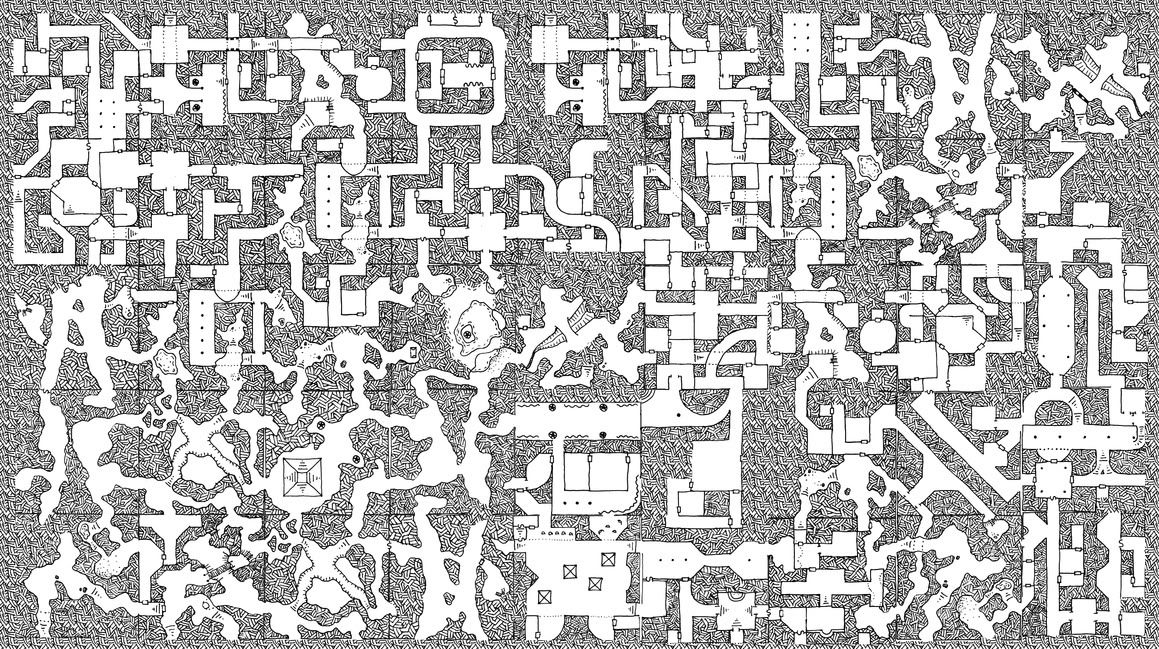
Monday, December 7, 2009
I Am Pretty Sure I'm The Only One Who's Ever Had This Particular Weekend
Friday:
-Played D&D.
-Went to a party in the apartment across the hall from where one of the girls in The Donnas lives.
-Watched friends play Rock Band in apartment.
-Listened to anecdote about how neighbors across the hall aren't good at Rock Band even though there's a Donnas song in Rock Band.
-Played a ten-year-old unnamed party game of my own devising.
-Played Munchkin for the first time. Almost lost to a Suicide Girl.
Saturday:
-Went out to buy funny sunglasses for a photoshoot for a magazine cover story about me next weekend.
-Wrote a D&D actual-play-report blog (with analysis).
-Went to a porn party with Mandy.


-Watched dates with some porn actresses get auctioned off for charity.
-Realized I had "worked" with 75% of them.
-Went out and ate Japanese food with Mandy and Sasha Grey and her guy, Ian.

-Came home and wrote a blog post about a random dungeon generation method.
Sunday
-Woke up and started using that method to generate a dungeon.
-Had a Vice Magazine TV crew come over and film at my apartment.
-Had threeway sex for Mandy's website while the Vice people filmed it.
-Finished my dungeon.
-Played D&D.
-Went to a party in the apartment across the hall from where one of the girls in The Donnas lives.
-Watched friends play Rock Band in apartment.
-Listened to anecdote about how neighbors across the hall aren't good at Rock Band even though there's a Donnas song in Rock Band.
-Played a ten-year-old unnamed party game of my own devising.
-Played Munchkin for the first time. Almost lost to a Suicide Girl.
Saturday:
-Went out to buy funny sunglasses for a photoshoot for a magazine cover story about me next weekend.
-Wrote a D&D actual-play-report blog (with analysis).
-Went to a porn party with Mandy.


-Watched dates with some porn actresses get auctioned off for charity.
-Realized I had "worked" with 75% of them.
-Went out and ate Japanese food with Mandy and Sasha Grey and her guy, Ian.

-Came home and wrote a blog post about a random dungeon generation method.
Sunday
-Woke up and started using that method to generate a dungeon.
-Had a Vice Magazine TV crew come over and film at my apartment.
-Had threeway sex for Mandy's website while the Vice people filmed it.
-Finished my dungeon.
Sunday, December 6, 2009
Another Brick In The Wall Dungeon Generator
So the D&D blogosphere has gone hog-wild for Sham's w/o Walls playing-card based dungeon generator. Including me myself.
I found it, quite literally, inspiring, so I went and tried to think up a way to use a similar technique to generate a standard dungeon with some built-in cohesion.
So, without further ado, here's the...
"Another Brick In The Wall" Dungeon Generator
Take a tarot deck. Remove the major arcana. (I am using a tarot deck because, unlike regular cards, it's easy to tell "up" and "down" on a tarot card--this technique can easily be adapted to certain standard decks, however, depending on the design on the cards).
Shuffle the rest of the cards.
Lay out 44 cards in a 9 x 5 grid. Leave an empty space the size of one card somewhere in the middle--this is the starting point of the dungeon.
These are the 45 rooms in your dungeon. Adjacent cards that are both facing the same direction (both up or both down) are connected. Completely isolated cards are hidden behind secret doors--you may choose where the entrances to these rooms are.
Rooms represented by the "cups" suit are empty or contain non-functional, dungeon-appropriate-decor. Starting with the Queens, Kings, Knights and Aces, interpret the rest of the rooms according to the following rules for number and suit:
2-minor obstacle, mostly just demonstrates the nature of the type of dungeon you're in
3-dead/ruined/broken
4-hidden
5-standard, level-appropriate, site-appropriate, dangerous
6-funny or weird, plot-irrelevant
7-standard, level-appropriate, site appropriate, dangerous, useful if overcome
8-has a clue to how to treat a Knight
9-has useful information about a Queen
10-is related to or is of the same nature as the Queen, possibly a minion
Page-noncombatant, plot-relevant, minion or possession of Queen
Knight-fairly big deal, could be a benefit or a hazard, depending on how the PCs play it
Queen-major, bad, plot-relevant
King-major, bad, plot-irrelevant, unless there are no Queens on the table, in which case it's plot-relevant
Ace-beneficial (major)
Coins-Inanimate Feature/Object
Swords-Person/Monster + Inanimate Feature/Object
Wands-Person/Monster
(For example, a 7 of coins could be a room with a pit trap that, if evaded, could be used to trap a dangerous monster.)
I'll write one up and let you know how it turns out after I run some people through it.
Obviously, a more various dungeon could probably be created by using the whole deck, including Major Arcana and laying out more cards. May have to think up meanings for the major arcana later.
I found it, quite literally, inspiring, so I went and tried to think up a way to use a similar technique to generate a standard dungeon with some built-in cohesion.
So, without further ado, here's the...
"Another Brick In The Wall" Dungeon Generator
Take a tarot deck. Remove the major arcana. (I am using a tarot deck because, unlike regular cards, it's easy to tell "up" and "down" on a tarot card--this technique can easily be adapted to certain standard decks, however, depending on the design on the cards).
Shuffle the rest of the cards.
Lay out 44 cards in a 9 x 5 grid. Leave an empty space the size of one card somewhere in the middle--this is the starting point of the dungeon.
These are the 45 rooms in your dungeon. Adjacent cards that are both facing the same direction (both up or both down) are connected. Completely isolated cards are hidden behind secret doors--you may choose where the entrances to these rooms are.
Rooms represented by the "cups" suit are empty or contain non-functional, dungeon-appropriate-decor. Starting with the Queens, Kings, Knights and Aces, interpret the rest of the rooms according to the following rules for number and suit:
2-minor obstacle, mostly just demonstrates the nature of the type of dungeon you're in
3-dead/ruined/broken
4-hidden
5-standard, level-appropriate, site-appropriate, dangerous
6-funny or weird, plot-irrelevant
7-standard, level-appropriate, site appropriate, dangerous, useful if overcome
8-has a clue to how to treat a Knight
9-has useful information about a Queen
10-is related to or is of the same nature as the Queen, possibly a minion
Page-noncombatant, plot-relevant, minion or possession of Queen
Knight-fairly big deal, could be a benefit or a hazard, depending on how the PCs play it
Queen-major, bad, plot-relevant
King-major, bad, plot-irrelevant, unless there are no Queens on the table, in which case it's plot-relevant
Ace-beneficial (major)
Coins-Inanimate Feature/Object
Swords-Person/Monster + Inanimate Feature/Object
Wands-Person/Monster
(For example, a 7 of coins could be a room with a pit trap that, if evaded, could be used to trap a dangerous monster.)
I'll write one up and let you know how it turns out after I run some people through it.
Obviously, a more various dungeon could probably be created by using the whole deck, including Major Arcana and laying out more cards. May have to think up meanings for the major arcana later.
Saturday, December 5, 2009
Department of Lessons Learned
Quiet, uncharacteristically chilly Saturday morning in Los Angeles. Finishing off what's left of the game-day snacks. Hot chocolate. Dr. Pepper. Quietly analyzing yesterday's game.
Character Generation or, Inventing Brand New Stereotypes
Mandy says:
"Guys will totally call a new character "Smacky McFighty" (guilty) whereas girls agonize forever about their characters' names."
While I have seen these stereotypes broken, my two new players walked right into them. By the time we were ready to play, the only thing holding us up was Frankie trying to name her character. We ended up looking through the books for acceptable names. After the game, she still wasn't happy, and went around looking for new syllables to tack on the end.
Also playing to type, Frankie decided to play a dark elf rogue.
"Ok, so I got armor and weapons, what else do I need to buy?"
"Honestly, Frankie, you're the third elf rogue in the party, so if you need some lock-pick tools or ear-sharpeners you can probably borrow it from one of the other girls."
"Ok."
Similarly, Sam, the only guy in the party, named his character Jaren, rolled up all his wizard's stats in three seconds, gave him sleep and charm and a backstory, and knew all the 3e modifiers for all the ability scores. And knew how many rounds there were in a minute. And is a professional computer programmer.
Spend A Night In The Box
So the PCs (wisely, I think) decided to end last session sleeping in the room where they could turn themselves invisible. In the morning, the new PCs showed up.
Brief confusion ensued as Sam dutifully attempted to role-play being a confused wizard hearing but not seeing a bunch of friends in the next room, and all the girls tried to remember from last game how to make themselves un-invisible.
Then they saw an innocent bystander getting attacked by a creepy doll and fought it.
Lessons learned:
-Nobody remembers anything that happened two weeks ago. Including me.
-My players are bastards. They saw a guy fighting a creepy doll and begging for help, closed the door on him, then sat around and talked about shoes a little bit, then opened the door and decided to save him. Using acid.
"Uh, Mandy, if you pour acid on the doll at that range and miss, it'll hit the guy. Even if you don't miss, it might still hit the guy."
"So?"
"O-kay..."
Must remember this when attempting to motivate them later in the campaign.
-The creepy doll had ferocious and disturbing offensive capabilities combined with crappy defensive stats. This meant, in practice, that the old PCs managed to fuck it up long before the new PCs got to do anything. Should've realized that.
-The practical limit on the length of time my players can spend role-playing with any NPC is the length of time I can spend doing a funny voice before starting to feel self-conscious about how carefully and verisimilitudinously thought out and thoroughly backstoried everything in the campaign is. This is a shame since I'm really good at funny voices. Eventually, though, the internal irony kicks in and I start to go "Eighth Unseelie Kingdom of Kel Har Ganoth? What the fuck am I on about?" No-one's seemed to notice yet, so it's all good.
Earning Such Procreative Organs As Are Typical of Your Gender
After a brief recap by the old PCs of last weeks' plot to the new PCs, new PC Sam, excuse me--Jaren--said "Wait, you left a sick unicorn dying down at the bottom of a pit? You guys might as well turn in your vaginas."
Sam is not so much the conscience of the party as the-guy-who-is-actually-playing-an-rpg-of-the-party. In a reversal of the common stereotype, the girls--raised on videogames--are used to finding things to kill and then ways of doing that. Sam is the one actually trying to find reasons to do things. He's also the only one who instinctively addresses NPCs in first-person. Everybody else goes "I ask the guy about what's going on here and if he knows anything about it."
After brief consultation of the map (Oh yeah--we have a map!) everyone decides to Rescue The Unicorn.
Now, herein we encounter a philosophical problem...
Last session the PCs killed the things guarding the unicorn, then went off and licked their wounds.
Now they are, after some hours, re-entering the room.
I decided this would be a fine time to place something new behind that door, namely, the three-trapped-adventurers schtick from James Edward Raggi's "The Grinding Gear".
First, know that this schtick involves (presumably the un-save-vs.-able OD&D version of) a sleep spell.
Second, know that, lurking behind this schtick is the spectre of James Edward Raggian tough-titty-if-you-die-you-should've-used-your-ten-foot-pole/dying-builds character-makes-you-smarter-and-puts-hair-on-your-chest school of DMing.
Third, know that I would very much like to be able to subscribe to this school of DMing.
Fourthly, know that I cannot. For I do not choose my style of play and thenceforth recruit players to fit it. Rather, I recruit players from amongst people I know and like and think would like D&D and thenceforth set out to set things up such that they will be entertained, I will be entertained, and we will all entertain each other as much as possible.
Fifthly, know that in more than two thirds of my games this year I have at least one brand new player--someone who's never played with us, never played ever, and usually both. Generally, these people are curious about this game but have no idea what it entails or whether it would be fun. Also, I don't necessarily know what, in a game context, they find interesting. An intellectual challenge? A chance to role-play? Unicorns? Pie?
So this first session--and, around here, it is almost always someone's first session--is a feeling-out process. I feel like you can't just kill the newbie in his/her first encounter and hope that she decides that even though she has no idea what's going on or why she died or how she could've avoided it or how likely this is to happen again that this all looks fun anyway.
So: the sleep schtick procedes. I use the more merciful 3e version of sleep, which only ends up knocking out most of the party (including Frankie, the total newbie), rather than all of it. That's the good news. The bad news is, the remaining two party members cast sleep right back at their foes and then dispatch them quickly before everyone else wakes up.
So here I begin to worry. It's two encounters (and two hours) into the session, and my new player has gotten to do precisely fuck-all. She got to watch some people kill a doll, then sit on the sidelines while some more-oriented (both in-game and metagame) people talked to an NPC about some plot strands she was just managing to straighten out, then got to sleep through a fight. Yay!
Heavy is the head that hovers behind the screen...
But There's A Unicorn!
Sam has to go soon to drive somewhere and pick someone up. This is sad--especially considering Sam will be leaving for Berlin in a few days, but, on the other hand, now there's a unicorn!
Suddenly everyone is very concerned about saving the unicorn. (And also with patting it on its nose and giving it spare rations.) So much so that one of the three rogues actually thinks to check for secret doors at the bottom of the pit. And lo! There is one!
The unicorn will be saved! What a relief.
Then there's another door, behind which is an ominous clanking.
Frankie, still thinking like a video game, is convinced that "all my character can do is sneak". So she sneaks through the door and sees...
The Ingenious Giant Spider Stairwell Gimmick of Which I Was Inordinately Proud
There is a creepy giant spider (actually a literalized sword-spider, with actual swords grafted crazy-alchemist-wise onto its lower legs) crawling up and down the stairwell walls.
The stairwell has funhouse-mirrors all around. Each is different and represents some aspect of the reflected individuals' selves. Breaking the mirrors (by accident or design) destroys that part of the person's personality and (usually) cripples them in some entertaining way.
So obviously what's supposed to happen is the party goes down there and they fight the spider and every time they or the spider miss, a mirror breaks and whoever's in front of it goes all screwy and beating the spider becomes a weirder and weirder challenge.
I kept track of the relative positions of the players and mirrors using sticky notes labelled with the kind of mirror on the front (fat, skinny, stretched, concentric circles, etc.) and the effect on the back stuck on the table in the appropriate place in the stairwell.
But, Anyway...
For one reason and another, and despite Mandy coming just one away from randomly summoning another monstrous spider to fight the spider (she got a scorpion instead), the fighting of the spider in the shaft was more tactically mundane and less intelligible than I'd hoped. Crawl, hide, shoot, stab, crawl, effect nobody understands, hide, shoot, stab, etc.
Wary was I , and in my own small inventions much disappointed.
Then Frankie said, spontaneously "This is so much fun!". And everyone agreed. Then they killed the spider, smashed the mirrors and tried to get the unicorn down the stairs.
And I thought--Thanks Dave, thanks Gary--no matter what, your game is fun. Then I figured it was time to eat.
Ordering Thai Food
Lessons learned:
-Deciding what to get is hard, because the girls take forever to decide what to eat.
-Paying the guy is easy, because strippers always have lots and lots of ones.
Then There Was Another Door
"Ok, so what's everyone doing when you open the door?"
"I'm going to hide."
"Wait, Frankie, you're going to hide in this room before someone opens the door or you're going to wait for someone to open the door, then go into the next room and hide."
"I'm going to hide in the next room."
"But you don't know what's in the next room, you don't know if there'll be a place to hide, plus if you walk through the door, the person on the other side might see you and so you won't be able to hide."
"I'm looking at my character sheet and all my character can really do is hide, so I'm going to hide."
"Ok, Frankie, look in the kitchen, what if the next room is like the kitchen? Then there'll be nowhere to hide."
(Mandy) "You could totally hide in the kitchen."
"Ok, fine, let's say all that junk weren't in the kitchen, then you wouldn't be able to hide in the kitchen."
"Ok, but..."
"Guys, I'm just gonna open this door, and whatever happens happens..."
So Then Some Things Happened
So some things happened, some plot got developed, this whole dungeon was revealed to all be an elaborate patch on The Masque of the Red Death (the actual short story, not the Ravenloft campaign setting), and a helpful NPC appeared to point everyone towards the more interesting of the as-yet-unstumbled-upon features of the dungeon.
Let Us Now Pause To Examine The Performance of Our Remaining Players
 Mandy is not, fundamentally, a team player. She's the Wolverine of the party. She sits back and watches things develop, then when things start drifting away, she goes "I want to find this Duke!" or "Ok, fine, let's save the unicorn," and since she's a tiefling with 4 levels, cure moderate wounds, summon monster, decent saves and a 19 armor class, people generally do what she says.
 Connie is the door-kicker. Although she has to occasionally be reminded of what exactly a scimitar is, she is eager to use it, and use it first. She also finds hidden doors, smashes mirrors, fiddles with mysterious items, uses her lantern to set things on fire, and remembers to feed the unicorn. Though impatient, she isn't a hothead. In time, she may turn out to be natural D&D people. She seems to be happy as long as she's doing something. And if she isn't doing something she starts flipping through a magazine. Ok, I take that back--she is definitely natural D&D people. Only the magazine is Elle instead of White Dwarf.
 Satine likes to backstab. She also likes to tie people up. I also find myself asking her what her character's strength score is a lot because she's always shoving people around or grabbing people. What does this mean? Perhaps: She's always doing the thing that needs to get done after the door gets kicked down but before someone needs the cure moderate wounds. She's an opportunist. I also obscurely sense she's the most eager for some sanity or meaning to emerge from this dungeon.
 And Frankie...Of Frankie, much has been said. Though she is still being tested...
...And Then The Lizardmen
The party attempts to parlay. The lizardmen speak not the tongues of men or elves.
Mandy pokes one of them. They swiftly knock her unconscious.
A flurry of scimitars and backstabbing, Satine likewise gets knocked out. Everyone tries to drag the helpless party members out of the way.
Frankie then examines her trusty character sheet. What's this? Darkness once per day?
Now nobody can see but Frankie. Fight or flee?
Frankie is perilously indecisive.
In the ends she decides to fight solo while Connie bumps around in the dark. In-the-dark-backstabbing turns out to beat blindly swinging a halberd. Down go the lizardmen.
And Next Session?
Will I be able to impose thematic or narrative order on the door-kicking hack-and-slash-chaos this dungeon has become? Should I?
Will Frankie remain indecisive and character-sheet-bound, or will her eyes be opened to the full panoply of D&D?
How many syllables will Frankie's dark elf name have next? Will we be able to pronounce it before the game ends?
Is Mandy's 4th-level character way out-of-whack with everyone else? Or will everybody else soon level up to the point where they can take on fiercer foes?
Who else will show up next friday, and will they know how to play?
And, for god's sake, what about the unicorn?
I have a week to figure it out.
Character Generation or, Inventing Brand New Stereotypes
Mandy says:
"Guys will totally call a new character "Smacky McFighty" (guilty) whereas girls agonize forever about their characters' names."
While I have seen these stereotypes broken, my two new players walked right into them. By the time we were ready to play, the only thing holding us up was Frankie trying to name her character. We ended up looking through the books for acceptable names. After the game, she still wasn't happy, and went around looking for new syllables to tack on the end.
Also playing to type, Frankie decided to play a dark elf rogue.
"Ok, so I got armor and weapons, what else do I need to buy?"
"Honestly, Frankie, you're the third elf rogue in the party, so if you need some lock-pick tools or ear-sharpeners you can probably borrow it from one of the other girls."
"Ok."
Similarly, Sam, the only guy in the party, named his character Jaren, rolled up all his wizard's stats in three seconds, gave him sleep and charm and a backstory, and knew all the 3e modifiers for all the ability scores. And knew how many rounds there were in a minute. And is a professional computer programmer.
Spend A Night In The Box
So the PCs (wisely, I think) decided to end last session sleeping in the room where they could turn themselves invisible. In the morning, the new PCs showed up.
Brief confusion ensued as Sam dutifully attempted to role-play being a confused wizard hearing but not seeing a bunch of friends in the next room, and all the girls tried to remember from last game how to make themselves un-invisible.
Then they saw an innocent bystander getting attacked by a creepy doll and fought it.
Lessons learned:
-Nobody remembers anything that happened two weeks ago. Including me.
-My players are bastards. They saw a guy fighting a creepy doll and begging for help, closed the door on him, then sat around and talked about shoes a little bit, then opened the door and decided to save him. Using acid.
"Uh, Mandy, if you pour acid on the doll at that range and miss, it'll hit the guy. Even if you don't miss, it might still hit the guy."
"So?"
"O-kay..."
Must remember this when attempting to motivate them later in the campaign.
-The creepy doll had ferocious and disturbing offensive capabilities combined with crappy defensive stats. This meant, in practice, that the old PCs managed to fuck it up long before the new PCs got to do anything. Should've realized that.
-The practical limit on the length of time my players can spend role-playing with any NPC is the length of time I can spend doing a funny voice before starting to feel self-conscious about how carefully and verisimilitudinously thought out and thoroughly backstoried everything in the campaign is. This is a shame since I'm really good at funny voices. Eventually, though, the internal irony kicks in and I start to go "Eighth Unseelie Kingdom of Kel Har Ganoth? What the fuck am I on about?" No-one's seemed to notice yet, so it's all good.
Earning Such Procreative Organs As Are Typical of Your Gender
After a brief recap by the old PCs of last weeks' plot to the new PCs, new PC Sam, excuse me--Jaren--said "Wait, you left a sick unicorn dying down at the bottom of a pit? You guys might as well turn in your vaginas."
Sam is not so much the conscience of the party as the-guy-who-is-actually-playing-an-rpg-of-the-party. In a reversal of the common stereotype, the girls--raised on videogames--are used to finding things to kill and then ways of doing that. Sam is the one actually trying to find reasons to do things. He's also the only one who instinctively addresses NPCs in first-person. Everybody else goes "I ask the guy about what's going on here and if he knows anything about it."
After brief consultation of the map (Oh yeah--we have a map!) everyone decides to Rescue The Unicorn.
Now, herein we encounter a philosophical problem...
Last session the PCs killed the things guarding the unicorn, then went off and licked their wounds.
Now they are, after some hours, re-entering the room.
I decided this would be a fine time to place something new behind that door, namely, the three-trapped-adventurers schtick from James Edward Raggi's "The Grinding Gear".
First, know that this schtick involves (presumably the un-save-vs.-able OD&D version of) a sleep spell.
Second, know that, lurking behind this schtick is the spectre of James Edward Raggian tough-titty-if-you-die-you-should've-used-your-ten-foot-pole/dying-builds character-makes-you-smarter-and-puts-hair-on-your-chest school of DMing.
Third, know that I would very much like to be able to subscribe to this school of DMing.
Fourthly, know that I cannot. For I do not choose my style of play and thenceforth recruit players to fit it. Rather, I recruit players from amongst people I know and like and think would like D&D and thenceforth set out to set things up such that they will be entertained, I will be entertained, and we will all entertain each other as much as possible.
Fifthly, know that in more than two thirds of my games this year I have at least one brand new player--someone who's never played with us, never played ever, and usually both. Generally, these people are curious about this game but have no idea what it entails or whether it would be fun. Also, I don't necessarily know what, in a game context, they find interesting. An intellectual challenge? A chance to role-play? Unicorns? Pie?
So this first session--and, around here, it is almost always someone's first session--is a feeling-out process. I feel like you can't just kill the newbie in his/her first encounter and hope that she decides that even though she has no idea what's going on or why she died or how she could've avoided it or how likely this is to happen again that this all looks fun anyway.
So: the sleep schtick procedes. I use the more merciful 3e version of sleep, which only ends up knocking out most of the party (including Frankie, the total newbie), rather than all of it. That's the good news. The bad news is, the remaining two party members cast sleep right back at their foes and then dispatch them quickly before everyone else wakes up.
So here I begin to worry. It's two encounters (and two hours) into the session, and my new player has gotten to do precisely fuck-all. She got to watch some people kill a doll, then sit on the sidelines while some more-oriented (both in-game and metagame) people talked to an NPC about some plot strands she was just managing to straighten out, then got to sleep through a fight. Yay!
Heavy is the head that hovers behind the screen...
But There's A Unicorn!
Sam has to go soon to drive somewhere and pick someone up. This is sad--especially considering Sam will be leaving for Berlin in a few days, but, on the other hand, now there's a unicorn!
Suddenly everyone is very concerned about saving the unicorn. (And also with patting it on its nose and giving it spare rations.) So much so that one of the three rogues actually thinks to check for secret doors at the bottom of the pit. And lo! There is one!
The unicorn will be saved! What a relief.
Then there's another door, behind which is an ominous clanking.
Frankie, still thinking like a video game, is convinced that "all my character can do is sneak". So she sneaks through the door and sees...
The Ingenious Giant Spider Stairwell Gimmick of Which I Was Inordinately Proud
There is a creepy giant spider (actually a literalized sword-spider, with actual swords grafted crazy-alchemist-wise onto its lower legs) crawling up and down the stairwell walls.
The stairwell has funhouse-mirrors all around. Each is different and represents some aspect of the reflected individuals' selves. Breaking the mirrors (by accident or design) destroys that part of the person's personality and (usually) cripples them in some entertaining way.
So obviously what's supposed to happen is the party goes down there and they fight the spider and every time they or the spider miss, a mirror breaks and whoever's in front of it goes all screwy and beating the spider becomes a weirder and weirder challenge.
I kept track of the relative positions of the players and mirrors using sticky notes labelled with the kind of mirror on the front (fat, skinny, stretched, concentric circles, etc.) and the effect on the back stuck on the table in the appropriate place in the stairwell.
But, Anyway...
For one reason and another, and despite Mandy coming just one away from randomly summoning another monstrous spider to fight the spider (she got a scorpion instead), the fighting of the spider in the shaft was more tactically mundane and less intelligible than I'd hoped. Crawl, hide, shoot, stab, crawl, effect nobody understands, hide, shoot, stab, etc.
Wary was I , and in my own small inventions much disappointed.
Then Frankie said, spontaneously "This is so much fun!". And everyone agreed. Then they killed the spider, smashed the mirrors and tried to get the unicorn down the stairs.
And I thought--Thanks Dave, thanks Gary--no matter what, your game is fun. Then I figured it was time to eat.
Ordering Thai Food
Lessons learned:
-Deciding what to get is hard, because the girls take forever to decide what to eat.
-Paying the guy is easy, because strippers always have lots and lots of ones.
Then There Was Another Door
"Ok, so what's everyone doing when you open the door?"
"I'm going to hide."
"Wait, Frankie, you're going to hide in this room before someone opens the door or you're going to wait for someone to open the door, then go into the next room and hide."
"I'm going to hide in the next room."
"But you don't know what's in the next room, you don't know if there'll be a place to hide, plus if you walk through the door, the person on the other side might see you and so you won't be able to hide."
"I'm looking at my character sheet and all my character can really do is hide, so I'm going to hide."
"Ok, Frankie, look in the kitchen, what if the next room is like the kitchen? Then there'll be nowhere to hide."
(Mandy) "You could totally hide in the kitchen."
"Ok, fine, let's say all that junk weren't in the kitchen, then you wouldn't be able to hide in the kitchen."
"Ok, but..."
"Guys, I'm just gonna open this door, and whatever happens happens..."
So Then Some Things Happened
So some things happened, some plot got developed, this whole dungeon was revealed to all be an elaborate patch on The Masque of the Red Death (the actual short story, not the Ravenloft campaign setting), and a helpful NPC appeared to point everyone towards the more interesting of the as-yet-unstumbled-upon features of the dungeon.
Let Us Now Pause To Examine The Performance of Our Remaining Players
 Mandy is not, fundamentally, a team player. She's the Wolverine of the party. She sits back and watches things develop, then when things start drifting away, she goes "I want to find this Duke!" or "Ok, fine, let's save the unicorn," and since she's a tiefling with 4 levels, cure moderate wounds, summon monster, decent saves and a 19 armor class, people generally do what she says.
 Connie is the door-kicker. Although she has to occasionally be reminded of what exactly a scimitar is, she is eager to use it, and use it first. She also finds hidden doors, smashes mirrors, fiddles with mysterious items, uses her lantern to set things on fire, and remembers to feed the unicorn. Though impatient, she isn't a hothead. In time, she may turn out to be natural D&D people. She seems to be happy as long as she's doing something. And if she isn't doing something she starts flipping through a magazine. Ok, I take that back--she is definitely natural D&D people. Only the magazine is Elle instead of White Dwarf.
 Satine likes to backstab. She also likes to tie people up. I also find myself asking her what her character's strength score is a lot because she's always shoving people around or grabbing people. What does this mean? Perhaps: She's always doing the thing that needs to get done after the door gets kicked down but before someone needs the cure moderate wounds. She's an opportunist. I also obscurely sense she's the most eager for some sanity or meaning to emerge from this dungeon.
 And Frankie...Of Frankie, much has been said. Though she is still being tested...
...And Then The Lizardmen
The party attempts to parlay. The lizardmen speak not the tongues of men or elves.
Mandy pokes one of them. They swiftly knock her unconscious.
A flurry of scimitars and backstabbing, Satine likewise gets knocked out. Everyone tries to drag the helpless party members out of the way.
Frankie then examines her trusty character sheet. What's this? Darkness once per day?
Now nobody can see but Frankie. Fight or flee?
Frankie is perilously indecisive.
In the ends she decides to fight solo while Connie bumps around in the dark. In-the-dark-backstabbing turns out to beat blindly swinging a halberd. Down go the lizardmen.
And Next Session?
Will I be able to impose thematic or narrative order on the door-kicking hack-and-slash-chaos this dungeon has become? Should I?
Will Frankie remain indecisive and character-sheet-bound, or will her eyes be opened to the full panoply of D&D?
How many syllables will Frankie's dark elf name have next? Will we be able to pronounce it before the game ends?
Is Mandy's 4th-level character way out-of-whack with everyone else? Or will everybody else soon level up to the point where they can take on fiercer foes?
Who else will show up next friday, and will they know how to play?
And, for god's sake, what about the unicorn?
I have a week to figure it out.
Subscribe to:
Posts (Atom)