Saturday, January 19, 2013

THE WIZARD!!!!!

WIZARD/WITCH (Magic-User Variant)

...you start with your normal hit points and saves etc. Write those down. Do everything pretty much the way you would in your system.

However, when you level up:

For each new spell slot you get, roll on this table instead of just filling the slot…

1-68 Fill a slot with a spell as usual. Borrring.

69 I sense a great disturbance etc etc You have a form of postcognition that allows you to detect the presence of cast spells, eldritch creatures and the like (not omnipresent magic or currently magical things going on like Detect Magic could) in a given 30x30 foot area within the last day. You will know whether it was a spell or creature or effect or what. Re-rolling this allows you to know the nature of it broadly (enchantment, demon, etc). Re-rolling this a third time tells you exactly what it is. Re-rolling it a fourth time allows you to function as a walking "Detect Magic" spell. After that re-roll.

70 Further advancement will require you to placate obscure gods. You have to adopt a taboo a la the Wu Jen like:
* Cannot eat meat.
* Cannot have more treasure than the character can carry.
* Must make a daily offering (food, flowers, incense) to one or more spirit powers.
* Cannot bathe.
* Cannot cut hair.
* Cannot touch a dead body.
* Cannot drink alcoholic beverages.
* Cannot wear a specified color of cloth.
* Cannot light a fire.
* Cannot sit facing a specified compass direction.
Each time you re-roll this you need to take up another one.

71 Wizard Lie. You can tell one lie per day (one sentence long) and be automatically believed by anyone at least half your level (round up). Re-rolling this means you can tell two lies, then three, etc.

72 After long eons of patient and lonely research you've found it--that thing you wanted? The Star Swallower? The dragon egg? The mountain fortress? It's there. 4 sessions worth of adventure away or less. Tell your GM, who then must place it.

You must have a fair shot at it--like any other treasure, but there's no guarantee you will get it. If you don't get it by the fourth session you can keep trying or let it go and roll again on this table. However if you choose to roll again and then you do get the thing somehow anyway, you lose whatever gimmick you rolled. GM think up some clever reason why.


73 Cruel curse. This is basically a spell usable once per day. Range: 100'. Area of effect: 1 creature per level. Duration: 1 day/level Save negates.
To trigger the curse, the caster must observe the target  (any creature with fewer hit dice than the caster) perform the same action for at least two consecutive rounds. The caster may then invoke one of two effects: 
a) The target creature must continuously do one thing chosen by the caster that it was doing in the last two turns,
 or…
b) the target can never do some chosen thing it was doing in the last two turns.
The repeated/forbidden action cannot be anything the creature normally always does (breathe, touch the ground, etc). The effect of the curse can be something that will probably kill the creature in its current circumstance but it cannot be something that would inevitably kill it regardless of circumstance. For example: the curse could not compel a creature to stop breathing but it could compel a creature to continue walking in a straight line even if that line (in the particular situation) would lead it off a cliff.
No two Cruel Curses may be identical (which is why curses tend to be weirdly specific).

74 Your powers inspire awe in lesser beings. You have an exceptionally (though not supernaturally) intelligent and loyal henchman, hound or horse (your choice). This individual cannot be slain, kidnapped or otherwise traduced "offscreen" by the GM, so if he or she's in trouble and your PC is not around you get to play it out. Of you re-roll this and your previous one is not dead, you get to add another hit die to your pal.

75 BAH! You have glimpsed primal vistas both horrific and majestic in your meditations. The mundane world does not concern you. Immune to fear. If you re-roll this, your companions gain a +2 vs fear if they can see you, then +4 etc

76 You now have a familiar. It has one hit die. If you already had one, it has 2 hit dice.
Roll:
1 Cat
2 Crow
3 Weasel/Marmot
4 Toad
5 Pick one
6 Make one up that's approximately as powerful as one of the creatures listed
It obeys commands, you can see through its eyes and use its special sensory abilities, attacks on it affect you, too, blah blah blah

77 I think I know the counterspell for this… By making a successful saving throw you may turn any spell cast on anyone in line of sight back on the original caster. It's an immediate-interrupt of course but that counts as your action for that turn or the next turn. You can do this once per day. Each time you re-roll this result you get +1 to the save.

78 The dweomers are beginning to fear you. +2 to save vs spell. +1 more every time you roll this. 

79 The constant influence of interdimensional radiation has twisted your body. Gain a random deformity. Describe it. -2 to charisma checks where you're trying to make someone like you, +2 to ones where you're trying to intimidate them or freak them out. +2/-2 more each time you re-roll this.

80 The wyrdness has definitively infected you. You have a mutation that goes beyond mere deformity: an eye that floats an inch outside of its socket, a head with no neck supporting it, a third arm, etc. You can roll a random mutation if you like or pick something. You know those freaky wizards with like 3 extra faces that Thundarr The Barbarian fights? They rolled this a bunch of times.

81 This glove is made of sleep. Take a spell you already possess and bind it into an object. You may now use the spell twice per day and it functions as if you were a level higher. However: the spell is now bound to that object, not you. Whoever has the object can use it. Nonwizards and lower-level wizards use it as if it were cast by a wizard one level lower than you.

82 You always were reading ahead of the rest of the class. Receive a random spell one level higher than you are able to cast. Remember: random.

83 In case of fire cast lightning… One of your existing spells (pick one) is also attached to a form of the Contingency spell. A second "copy" of the spell is set to activate as soon as a trigger event of the caster's choice occurs. The caster may only cast and set a new contingency once a week. In essence, contingency means that rather than having 7 copies of a spell per week at will, the caster now has 8, but the 8th one is only activated by the specific condition. Re-rolling this result allows for another contingency to be set with a different spell.

84 Poorly memorized spell. The caster may select any spell of a level s/he is not normally allowed to cast, only it has a 50% chance of backfiring. Re-rolling this result improves the caster's odds by 1%.

85 Take what you can get in a world of Vancian scarcity… Receive 2 random spells of whatever the highest level you are able to cast is.

86 I know this foul pottery… Roll under int +1 on a d20 to identify obscure pieces of lore and magic items. Add +1 for each time you re-roll this until you get to 19.

87 You been practicing talking slowly and lighting candles. You get one 8th level spell of your choice as a ritual. (9th level if you are able to cast 8th level spells) This means either (your choice):
-it takes 24 minus your Int score hours to cast it and you have to stay in the same place (30x30 square) doing nothing else the whole time,  or… 
-you have to do some dumb elaborate ritual thing that takes only an hour as described by the GM for this effect
Either way the target/are of effect must be right there unless you have a separate scrying spell or suchlike and the spell must be used immediately. You may cast your ritual spell once per month. Rolling this again gets you another one.

88 All this watching people fight has actually sunk in. +1 to hit every time you roll this.

89 You are learning the languages of inanimate objects. You may ask and receive an honest answer from one once per day--plus one more every time you re-roll this.
90 The laws of the unseen world are ever more clear to you. You may write a magical contract. Anyone freely agreeing to such contract and signing it will take d6 damage per your level if they break it. The damage goes up by one die every time you re-roll this.

91 Look out world: You bought chalk! You may summon a demon or similar extradimensional creature with one less hit die/level than you have once a month. It will serve for 6 days plus one more for each time you re-roll this result. If you have a familiar, it will possess your familiar and serve through that. If you do not have a familiar but do have any henchindividuals, then it will possess them and serve through them.
When the time is up, the creature gets to stay on the material plane and do what it wants. So….good luck with that.
Re-rolling this result means you can summon a creature with HD equal to your level, then one more, then one more etc etc

92 The souls of common folk are easily read. On a successful wisdom check you can read both the aspect and aura of anyone at least 2 hit dice/levels lower than you. You know if they're lying, if they are under magical influence, and if they are what they seem. Re-rolling this adds one to the check.

93 You crackle with misappropriated energies. On a successful save against magic you not only successfully resist a spell, you may release it any time in the next 8 hours--effectively casting that spell as if it were your own. You may not cast any other spells until you release the stored spell. This only works on spells that affect only you or an area only you and/or your familiar occupy (like if Rock to Mud was cast and you were the only one in the room, you could absorb that). If you re-roll this result, you may use it on spells targeting you and one other person, if you re-roll it again then it goes for you and 2 other targets, etc etc.

94 Stuff that shouldn't come off does. You have one removable limb or organ (pick: hand, eye, heart, etc). It functions as normal when separated from you and you receive any sensory information it picks up. It can travel a maximum of 100' from you before you are in trouble. Each time you roll this, pick another.

95 The sorcerer has a second shape... You can turn into one other thing at will because hey, wizards sometimes are like that. It can be another humanoid shape, like just some random otherwise-looking person or it can be an ordinary animal somewhere between your size and cat size. You have to decide what the thing is: its stats are exactly the same as yours and it has no special movement or sensory powers. I mean, if it's smaller than you it can move through smaller doors but otherwise whatever. Each time you re-roll this you get one other shape you can assume.

96 Your studies have unleashed a wild dweomer into your mind. Basically this means you have one spell (of whatever level you were rolling this result to replace) which is totally random each morning. Roll to see what it is. Re-rolling this result means you get another one plus one extra random spell each morning. And if you re-roll it again you get another plus two extra, etc. So the first time you do it you're like "Mannn, I shoulda just played a regular wizard" but after that you start racking up bonus random spells, which is nice, right?

97 Vile indeed is this corrupted earth…so you hover an inch above the ground at all times because magic. If the ground falls out from under you you still fall, you just land an inch above where you normally would. -d6 to all falling damage. -d6 more each time you re-roll this result.

98 What the hell is he doing over there…? Your unnatural metabolism no longer handles what humans call "food". You eat something else--pick--it must be something that might be present in a forest but not in a bare prison cell. Likewise, your blood, tears, sweat, saliva, etc no longer "taste" human and there is a 1 in 10 chance carnivores will ignore you. This chance goes up by one each time you reroll this result.

99 Zubzubzub ZAAAAAA Once you cast a spell you may hold it to increase its power. It can only be an attack or otherwise baleful spell (not healing or whatever, got it?). You may do nothing else but walk, chant magic words, and make wizardy spellcasting gestures while holding the spell and if you are interrupted the spell is lost. However, for each round the spell is held, either it works as if cast by a wizard one level higher or the save is at -1 (pick). You may do this once per day. Twice if you re-roll this result, three times if you re-roll it again, etc etc

00 Spooky wisdom. If you sleep, you will receive a minor prophecy in a dream. It will communicate some true or likely thing about the outcome of whatever's on your mind as you sleep.

Tuesday, January 15, 2013

The Alice: A PC Class for any kind of D&D

from A Red And Pleasant Land, the upcoming Alice module...
Pic by me. Clicking makes it bigger.

Alices (when male: "Alistairs" or, of either sex: "Fools") are unlike other adventurers in that they are actively sought by adventure. Alices forever find themselves falling into cursed rabbit holes, accidentally killing witches, having their half-brothers stolen by goblin kings, being willed magic rings, finding demons inserted in their chests or having armored knights ride through their homes while they are trying to sleep. Obscure gods, however, sympathize with them (they are often born to powerful families), and an Alice is a boon to any party. Some Alices wear striped stockings, some Alistairs wear pointed shoes. 

Although they begin their adventures untrained and naive, Alices are fast learners, and high level Alices are known for their sagacity and cunning.

Inserting an Alice into any system is simple--in general they are treated as thieves/rogues/specialists. Details:

Race:

Alices are always humans or halflings (though some say they are a race unto themselves). In systems which treat race as class, you could say the Aliceness of an Alice supercedes its Halflingness.

Hit Points:

Alices accumulate hit points as wizards/magic-users

Attacks:

Alices attack as thieves/rogues/specialists.

Skills: 

At first level, and usually thereafter, Alices collect skills like thieves/rogues/specialists. The automatic specialist skills in LOTFP are: Climb, Search, Find traps, Sleight of hand, Sneak attack, Stealth and Tinker. These all start at a 1 in 6 chance* and go up by one each time you add skill points. The exception is sneak attack which starts at normal damage then goes to double damage then to triple, etc. Anyway: at first level add 2 skill points anywhere you want to your skill list as opposed to the usual 4.

They search for and detect traps at +1 (if these are two distinct abilities in your system, pick 1).

If you are not using LOTFP follow that asterisk for suggestions on how to allocate your 16.6666 repeating percent improvement. Or if you're using a system with a thief-abilities-by-level chart (like AD&D), you could just interpret "using your 2 skill points" as moving up one level up on the chart. If you do this you'll eventually end up with something like a 6th level thief who performs thief functions at like 3rd level plus has a few of the below gimmicks. Not as hard to keep track of as it might seem so long as (like wizards everywhere) you write all your important stuff on your character sheet.


Saves: 

If you're using a 3-save system, give yourself a +1 dex save, if you're using LOTFP or another old-style Death Ray save system, give the Alice saves that are one worse than usual for a thief. In LOTFP that's: Paralyze 15, Poison 17, Breath 16, Device 15, Magic 15.

Exasperation:

In addition, in times of unusual stress Alices may become Exasperated. This Exasperation causes fate to take notice of the Alice, and then to aid her. The Alice says or thinks something like "Oh I can't conceive how I ever fell into this deplorable circumstance!" or "We are indeed doomed and the rats will gnaw our eyes."

Practically speaking, an Alice may express Exasperation once every real-time game hour (as games focus almost exclusively on stressful times, these represent the periods during which the gods are most likely to take notice). When this happens roll the dice.

At 1-5th level roll d4, at 6-7th level roll d6, at 8-9th level roll d8, at 10-11th roll d10, at 12th level and higher roll d12:

1-A secret door is revealed where none had previously been detected. If the GM has made no provision for a secret door, it leads to the nearest unexplored area.

2-The Alice realizes she has something in her pack, her hair, or otherwise secreted about her person. The object can be anything non-magical and generic (a key, not the key) that exists in the setting and that is small enough that the Alice could reasonably have it hidden it in her current condition or smaller than a breadbox, whichever dimensions are smaller at the time. The Alice may choose what this is.

3-An ordinary animal--cat sized or smaller--appears. The Alice cannot directly control it but it will not under any circumstances hurt the Alice.

4-A fact about the situation at hand occurs to the Alice--a piece of local or monster lore, perhaps something she read or was once told in a parlor or a lesson or in a kitchen.

5-Someone of the Alice's choice falls down. (Line of sight.)

6-The weather in the immediate area changes in a way decided by the Alice--the change is general and may not be targeted (no aimed lighting bolts or gusts of wind).

7-A nearby creature is charmed by the Alice for an hour. (Line of sight.)

8-An inorganic device or object of the Alice's choice breaks. (Line of sight.)

9-Something not ordinarily able to talk (GM's choice) begins to speak to the Alice.

10-Creatures present complete forget the Alice is there for as long as the Alice keeps making saves vs spell.

11-Someone is sent to fetch the Alice out of her current predicament. If there is an obvious candidate from among the local NPCs (giant eagles, a friendly knight...), that's who it is. If there isn't, then: hey GM, time to make up a weirdo. The NPC does not automatically have the ability to extricate the Alice from the situation, s/he merely appears as close as is plausible.

12-Someone or something of the Alice's choice begins to shrink at 1 foot per round down to playing-card size. (Line of sight.)

These effects are magical and can be countered as magic.
You can totally click to enlarge this, too
Leveling up:

At first level and every time you level up, roll twice on the table below. What happens if you roll a thing twice (consecutively or otherwise) is also explained.

(Some of these include stuff about ability score bonuses, if you have an ability score minus, just ignore that.)

1-20 Alice was then reminded of something she'd noticed before... +1 to all your saves.

21-70 Falling down wells really improves the hand-eye coordination: 2 skill points or just slide up to the next thief-function bracket if you're using 1e or something.

71 You're very perceptive, if nothing else. For each combat round you spend just watching someone (i.e. you're not doing anything except maybe moving and you are not being attacked yourself) you get +d10 to hit and +d10 to damage or +d10 to any attempt to trip, grab, or otherwise mess with the target when you finally do decide to attack. This only works on targets that are engaged in combat while they are being observed. The ability can only be used once per fight on anyone smart enough to notice what you're doing. Also: only works on things with organs (like, not on oozes). Re-rolling this raises the die to d12 then d20. After that you start getting 2d10 then 2d12 then 2d20 etc.

72 Alice liked pies, although sometimes people did not want her to have them. Add your level to any attempt to locate any foodstuff of any kind. Re-rolling this this just adds +1 more up to a maximum of 10. After that the bonus applies to any organic material. After that it's a wasted roll.

73 She closed her eyes and said the words as she'd been taught... You have learned one magic-user spell. It functions as if cast by a 15th level wizard or your level whichever is higher. Determine the spell randomly (d8 for level). It works once, that's it.

74 Oh, I do so apologize... You can super-easily trip any basically human-sized creature that is otherwise engaged with someone or something else on a successful roll-under dex d20 roll. This only works once per fight unless the enemy is mindless like zombies or for some reason can't see you pull off this tactic. Re-rolling this result means the trip does damage: d4, then d6, then d8 etc.

75 Her aunt had mentioned them ... +2 to recognize the faction or function of any aristocrat in any land. It maxes out at +6. After that, for each time this bonus is re-rolled, you are cousin or niece or otherwise secondhand related to the number (whatever number over 3) of NPCs encountered thereafter of your choice.

76 All that hiding in the dumbwaiter has finally paid off. You know a secret. One of two kinds of secret, to be precise: either a piece of useful lore about a legendary treasure or magic item that you encounter or an embarrassing fact about an NPC. Mechanically: once per session you may astound your party's condescending wizard by pulling this lore or rumor out of your petticoat or pantaloon by making a successful roll-under int check. If you fail, screw it, you can't do it this session. Re-rolling this means you try for this twice per session, then 3 times, etc

77 It seemed nearly everything was dangerous if handled improperly. You've become very skilled with improvised weapons--they do one die category larger than they should If you garotte someone they automatically lose a turn on a successful hit, if you drop caltrops or marbles and someone with two legs steps on them they will automatically fall down (at least the first time). Re-rolling this result adds damage to any of these +2, +4, +6 , etc

78 It was very shiny and stuck out like a soup spoon... On a successful melee hit, you may immediately make a Sleight of Hand attempt to grab an item (other than the target's weapon) off a target. This won't work twice on anyone above zombie-intelligence who sees it. Re-rolling this result means you get a bonus to the sleight roll for each re-roll +1, +2, +3 etc.

79 She was not such a mouse as she used to be. +1 Dex to racial max, excess goes to Str or Con.

80 Alice then did something quite astonishing... You are surprising. +(entire charisma score) to hit with any suddenly improvised weapon the first time you strike against any intelligent foe (who knew what you could do with a gingerbread man?) and add your whole charisma score to the damage. This trick only works once per fight. Re-rolling this adds +2, then +3, then +4 to the damage, etc.

81 The blue one certainly did make you taller, of that Alice was sure... You are +1 to identify drugs and plants with drug-like properties for each time you roll this.

82 She could be very charming when she needed to be. Your silver tongue gives you a +2 charisma bonus to lying. If charisma checks don't come up much in your game, just say someone of ordinary intelligence you can talk to will pretty much automatically believe one lie you tell per day. If you re-roll this result it goes +2 more, +4, +6 etc. or extra lies per day.

83 "It really was curious," she thought--"How many times could this kind of thing happen?" You may escape death or another equally awful fate exactly once. You must spend at least a round playing possum to build tension but....surprise, you jumped out of the way just in time! Re-rolling this means you get to do it again.

84 She knew to curtsey at times like this, and so she did. Despite the low company you keep, you've been working on your manners. Members of the upper classes instinctively recognize you as one of their own. +1 to charisma rolls or reaction checks when dealing with them for every time you roll this.

85 It was so lovely, and--according to the book--it was right there. The dress made of manticoreflesh, the house full of lilacs, the magical fishgutting knife---whatever the thing that you always wanted is, it's there. 4 sessions worth of adventure away or less. Tell your GM, who then must place it.

You must have a fair shot at it--like any other reward, but there's no guarantee you will get it. If you don't get it by the fourth session you can keep trying or let it go and roll again on this table. However if you choose to roll again and then you do get the thing somehow anyway, you lose whatever gimmick you rolled. GM think up some clever reason why.

86 She had not known her mother's cousin very well, and decided that it was a bad thing that she had died...You have been willed 5000 units of the local currency (GP? SP? Kroner?) worth of random mundane (nonmagical) objects. Here's how it works: you have exactly ten seconds real time to say what you bought. You now have all that stuff, assuming it adds up to less than 5000gp. You do not get xp for this treasure.

87 They kept talking as though Alice was a rhododendron in a pot. Add 2 to your stealth each time you roll this. If you max out, that's that.

88 She knew from school what the word meant, but did not know if it was rude or not. Add 2 to languages skill or choose a new language to read and speak.

89 Alice quite liked drawing, and had an impressive box of crayons at home. You are adept at forgery.  It's a your Int vs. their Wis roll, assuming you have access to about 40 gp worth of stuff or the kind of materials you'd find in a civilized area. Every time you re-roll this you get +2 to the check.

90 She thought it might be a saltcellar, or at least that seemed like the right word for it. You can appraise treasure to a nontrivial and nonboring degree: you can estimate the value of nonmagical things flawlessly and if a piece of treasure is not what it seems on any level you will get an inkling. As in, you'll go "Is this not what it seems?" and the GM will go "Yeah, you've seen a lot of jade urns in your day and this is not what it seems somehow--you're not sure how." If a treasure has some unusual or hidden feature of a mechanical or physical nature you will sense that it is there on a successful Int roll. You won't know what it is, but you'll sense that it is there. You also have an extra +1 (in 6) and + int bonus (if any) chance to notice unusual features or traps in rooms if you are familiar with the culture that built the room. If you re-roll this result you are reading now, just roll again.

91-93 She did seem to offend people (and animals) wherever she went. You've become adept at dueling. You may add your dexterity bonus instead of your strength bonus to hit with a foil, rapier or similar weapon (if the mechanics of your game already allow that, you can add it to damage). Each time you roll this result thereafter, you are at +1 to hit in any formal (challenged and accepted) duel with any dueling weapon you have used as a weapon before. r.

94 They all listened attentively as Alice told her tale. +1 Cha. to racial max, excess goes to Wis or Int.

95 They began to throw stones, and Alice began to avoid them  +2 to reflex save or whatever saves can plausibly be derived from "jumping out of the way" in your system. If a save normally means you take half damage, you take none.

96 She began to feel somewhat neglected. If you are attacked in a round that you spend doing nothing but dodging and your attacker misses, s/he or it will not only miss but fuck up and lose his or her next turn (if s/he or it has multiple attacks, s/he will lose a number of attacks equal to your level). This only works once on anything of better than zombie intelligence that sees it happen. If you re-roll this result, you get it twice, then three times, then four, etc.

97-98 She tried to remember what she knew about stoats. +1 to reaction checks or charisma rolls from all ordinary animals and talking-but-otherwise-ordinary animals.

99-00 Alice had seen so many unusual things lately, it had become usual. You've seen and done so much that nothing phases you--you are immune to insanity or confusion in any form. Even mind-altering cosmic horrors from the far edge of the cosmos are like whatever. You still do fear. Fear is good. Fear keeps you alive. Re-rolling this means any allies who can see you likewise get a bonus (+2) to their saves on account of your steady eye.


The Alice player must not become dizzied by this wonderland of combat options. You get 10 seconds to pick what you're doing once it's your turn.

__________________________________
*Note on using the LOTFP skill advancement in other systems:

So the LOTFP skill system is--Base skill (everybody has this): 1 in 6, If you are a specialist and level up a skill you get 2 in 6 then 3 in 6 etc...

That's about a 16.6% improvement per advance.
Here are some slightly-more-ability-score-sensitive versions with fairly similar (not exactly the same) math if you want 'em...

.In a D20 DC-style system: Add your stat bonus for every advance. If you want to match LOTFP, assume the DC is usually 20 and the starting point for anybody is a roll + stat bonus.

.In a D20 DC-style system but you're still using the old style ability bonuses (i.e. 13-15 is +1, 16-17 +2 etc) then add stat bonus x 2 for every advance. If you want to match LOTFP, assume the DC is usually 20 and the starting point for anybody is a roll + 2x stat bonus.

.Roll-under: Roll under stat minus 10. Add +d6 to your stat for purposes of this skill for every advance.

. Percentile: You start at (your ability score)% chance and add your ability score again every advance.)

Friday, January 11, 2013

MonstersLikeWhoa


These fantasmagorical biohorror monster miniatures are from a new game called Kingdom Death which looks so fucked up in a good way.

Mandy Morbid, our head miniature reviewer here at D&D With Porn Stars says:

"I think the one with the boobs is pretty amazing".

They're big, too, sculpted at 35mm-- which means the people would be big for an RPG, but monsters
are whatever scale you want them to be.

If anybody gets a copy of the game, let us know what it's like.

-

Thursday, January 10, 2013

The Church of Vorn

(With apologies to Wikipedia...)
The Church of Vorn, also known as The Church of Iron and Rain, is the North's largest human church. It is among the oldest institutions in the world and has played a prominent role in the history of Western civilisation. The Church hierarchy is led by the Pope and includes cardinals, primarchs, bishops and sisters superior, inferior and imperator. The Church teaches that it is the 8th Church founded by Denizen the Abhorred, who has apostolic primacy.
The Church maintains that the doctrine on faith and morals that it presents as definitive is infallible under the current dimensional dispensation, however it believes that the nature of the dispensation may change or may have already changed due to the nature of time, which consumes reason and all things. There are a variety of doctrinal and theological emphases within the Church, including the Eastern OscLithic Churches and religious communities such as the Monks of the Thousand Inimical Pyres, the Maximites and the Hog Children.

The Church of Vorn defines its mission as spreading the 120 Accuracies of the Tired God, administering the adjudications and exorcising deviants. The Church teaches that the rusty water used during the Mass saturates the body with the capacity to despiritualize enemy gods. The Church practices closed communion and only tattooed members of the Church in a state of failure, decay or desperation are ordinarily permitted to receive the Obscure Unction.
The Church holds the Bleak Sister, as sibling of Vorn, in special regard and has defined four specific Bleak dogmatic teachings, namely the transcendence of her vengeance, her status as the claw of Vorn, the invulnerability of her flesh, and her role as first Amazon.
The Church's hierarchy is headed by the Archbishop of Vornheim, the Pope, who is the leader of the Northern Church. The current Pope, Margrave the Oval was captured by the dragon, Ferox the Incinerator, shortly after his election and previous to the disappearance of Lord Thrawl from the throne of Vornheim.
The pope's ecclesiastical jurisdiction is called the "Touched Places", or the "Denizolic Empire" (meaning the lands of Denizen the Abhorred). Directly serving the Pope is the Eminent Sisterhood, the central governing body that administers the day-to-day business of the Church. 
Paladins of Vorn have prophetic dreams and drink heavily. Those of the First Order may not heal wounds to the eyes by "Laying on Hands". Those of the Third Order may use their Smiting ability for double damage against fire demons and salamanders, but do only half damage to creatures of mist or water.
Clerics of Vorn have the option of taking Rusting Grasp instead of a usual spell at 2nd level. They may only use pointed weapons, as hypocrisies are inimical to the Lord of Rust and Rain.
It is said that Vorn himself, after having his eyes torn out by Ferox the Incinerator, sleeps beneath Deathfrost Mountain.

The whereabouts of the eyes themselves are a source of great conjecture and rumor.


Tuesday, January 8, 2013

Dueling Campaigns

So there's this: Running an on-line campaign where the party's goal is to find and capture the party in your real-life campaign is both fun and educational.


When last we left the girls they were gingerly dealing with this maxxed-out dragon.

They grabbed some loot and went out into the hexjungle to find some means of dealing with the creature.

Which is always fun, right? You see a big bad and then the players, rather than turning it into one more disconnected episodic encounter, decide to move off and fight another day, keeping that looming threat in their mind. Like they're doing the foreshadowing for you.

So: back off into the irradiated jungles of Cobalt Reach.

Some very impressed goblins (we're at that neat point in the campaign, a few years in, where the players are 7-10th level and have some history and are obviously terrifying to everyone they meet) tell them their best bet for weapons is the rolling fortress of the Star Witch...


...which trundling monstrosity they then sneak aboard.

Then somebody's mom makes cookies and the session ends.

________
Meanwhile in Hollywood I agreed to run a game on-line last Monday.

"So y'all got a choice: take an assignment from the beleagured city of Vornheim, currently besieged by the undead and the goblin lords of Gaxen Kane, or take an assignment from the aforementioned Goblin Lords of Gaxen Kane"

Vote: Goblin Boss job it is.

I was kinda thinking it'd be nice if the on-line people helped save my city--after all, I got books to sell. But no, anyway...Goblin job.

The Goblin King has a grudge from a long time ago.

This goddamned pink-haired war witch and her warband not only humiliated him but reports from the southern frontier indicate they are contriving to discover some kind of mcguffin to save the doomed city.

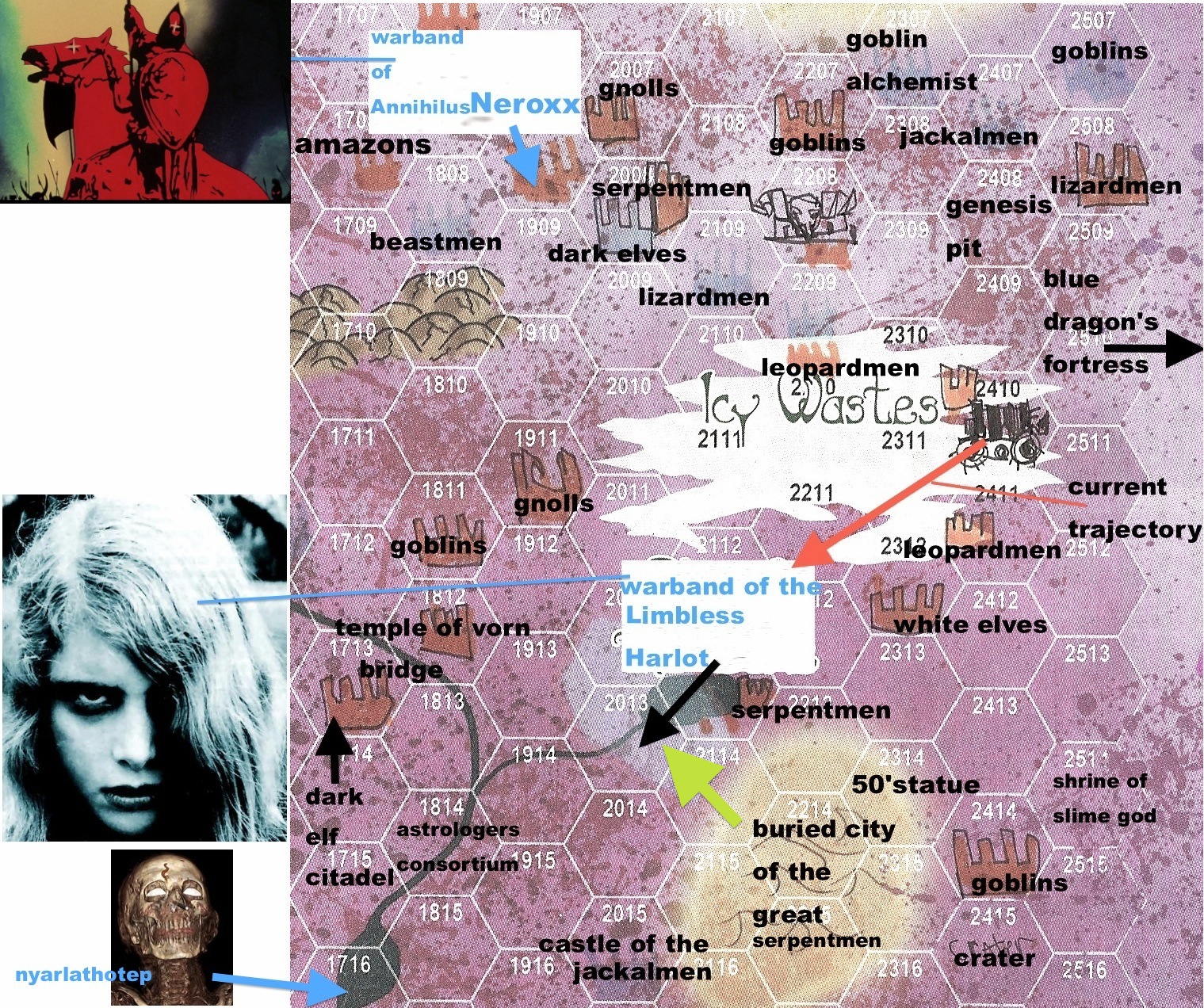
So, the assignment for the online group: go hexcrawl around and find them.

_____
Now basically, in a sandbox, you have to have about a gazillion half-sketched ideas in every direction and then be prepared to build up on them when the party moves that way. It's a constant back and forth between planning and improvisation and, in the shuffle, some stuff can get lost: the PCs find a problem, half-solve it, have some fun, but then go "Fuck it" and move on 'cause there's D&D in every direction.

The great thing about having the second party chasing the first is that consequences of the party's actions (the engine of typical, structured dramas) suddenly spring up out of everywhere. Things have history and NPCs have allegiances without you even having to try.

So this second party starts looking for the girls: they find the tracks the rolling fortress has left through the jungle. They run into a herd of centigors who kidnap their totally redshirt wizard.

The first party sees this herd of centigors carrying the limp wizard in the next session and has to hide from it.

The second party finds where the rolling fortress clearly ran smack into that lake near Hex 2114 and was attacked by the warband of The Limbless Harlot (like that but, y'know, without the arms and legs). They have to do some forensic work to reconstruct the events.

The first party has abandoned the fortress and made off across the Reach to parts unknown, tangling with and taming an ocelot, and resting with some allied goblins.

The second party likewise makes an impression on some local goblins--the fact that Jez's goblin PC rolled as well as he could on his charisma plus strolled into town riding a man pretty much blew these hicks away--and also a citadel of creepy carrion-crawler god-worshipping serpent cultists who waste no time creepily tattooing party #2 and doubly charging them with the mystical task of finding the troublesome war witch and taking all the magic war witch stuff she probably just looted from the rolling fortress.

The War Witch herself is meanwhile sitting right next to me listening to all this on the laptop and occasionally commenting to Party #2 to the effect that she's noting their various levels and Armor classes. I put it down to prophetic dreams.

And, basically the point is all that thinking you do in a sandbox campaign when you go "Ok, there's a village-- why do they care? What do they want?" between and during sessions is largely done just by GMing the other game. Each party is creating the background action animating the other party's sandbox.

It might sound like a crazy juggling act but in actuality it makes it all much easier--I know exactly what's going on in the whole area all the time because I just GMed it. If I had just written it all out it not only would it've been lonelier but harder to remember.

I suppose if group 2 ever does find group 1 I'll have to schedule a party so they can fight.


Monday, January 7, 2013

Well Designed For Who?*


Well-Designed

It's well-designed.

Meaning what?

It reliably provides a certain experience.

To who? It didn't provide it to me.

Well....(thinks)....to most people.

Most people don't play RPGs, and of those, most of them haven't played this one.

Mmmmm...to most people who...want...to...have that experience....already? Aaaand...didn't get it with that other game? Aaaand who....

___

Here's the problem we have when we talk about "objectively good game design".

It isn't about providing a certain experience reliably.

Focused design is, at best, about:

Providing a certain experience reliably to a given audience.

Good game design, on the other hand, is about:

Providing any game tools the audience enjoys using to a given audience.

There's a difference because Focused Design assumes an audience so small and homogenous that you can actually reliably provide them an experience.
Easy Examples 

Let's take a look at a couple "successful" independent RPG products. Products that sold well in their categories and made money for their authors and won fabulous prizes.

Here's Dogs In The Vineyard. Its author says this:

"It's a game where you're a teenager with a gun and a book, and you're sent out to solve problems between adults that can't really be solved with either. If that sounds fun to you, you might enjoy the game, and if it doesn't, you won't."

So here we've got the experience it's supposed to provide and a description of an audience that it is supposed to provide that to. That audience seems to be very happy about it.

The experience is you're some western proto-fascist religious weirdo passing judgment on rural towns, the audience is amateur game designers and people who hang out on their forums who are into westerns and/or judgment and/or dealing with soap operatic moral issues in games and/or the kind of people who go to gaming conventions and see that game description and are like "Yeah, I'm on that".

How big that audience is or could potentially be is unclear, but it seems fairly true that within that audience those people are happy with that thing and get that thing out of it. He sold his copies. They don't complain much from what I've seen.

They are people I do not understand who want a thing I do not understand why anyone would want it, but they get it and are happy with it. If we define "good design" as giving the experience people expect to a defined group of people, it succeeds.

So then we got a book that sells about the same rate, my book, Vornheim: The Complete City Kit (I would love to use another book instead of my own for this example, but I needed something where I knew a lot about the sales figures and audience response from a different audience than Dogs.)

It provides a bunch of tools for making up an interesting, useful fantasy city in the middle of running an RPG to an audience that: 

1. Knows how to play an RPG
2. Has a ruleset already
3. Is ok with improvising content
4. Does not want to memorize a lot of content
5. Wants to run an open sandboxy campaign
6. Is ok with a few weird results mixed in
7. Is adults
8. Likes the tone set by the fairly dense, fairly inky artwork,
9. Plays older versions of D&D or is used to/good at converting on the fly to their system of choice
10. Is into the same kind of weird sword and sorcery fiction old and new that inspired it, and
11. ...probably reads a lot about games on-line and probably reads this blog

That's a very specific audience. But that audience seems to like it. It sells well and there are few complaints in my mailbox.

It provides that thing to that audience. Its tools are "well designed" in that sense.

____

Point is: both of these different products succeed not necessarily because they are objectively well-designed in any way, really. They succeed largely because they were very good at finding the audience that wanted them--mostly by capitalizing on social networks where people talk about games that were already there and telling those networks who their authors were and what they were about.

Change the audience and suddenly the experience changes completely. I played Burning Wheel--which is supposed to be a game of beliefs being challenged in epic struggles--and it came out as the funniest light-comedy game I ever saw.

_____

Hard Examples (Mainstream Design)

Now here's the rub for bigger games--Vampire, RIFTS, Call of Cthulhu, D&D etc.

If we are judging whether they are "well designed" we have to take into account that both parts of the "focused design" equation are (by necessity and design) waaaaay more ambitious than what Vincent and I were going for.

Like with Vampire, the focused design brief pretty much has to be:

Provide tools for much any kind of adventure conceivable where you play a vampire in a contemporary world full of secret, hidden vampires to an audience consisting of anybody in the world who thinks playing a vampire in a world full of secret, hidden vampires is a good time and which has maybe seen Lost Boys or read Anne Rice and liked it.

The number of bases to cover is bigger, the audiences are bigger.

This is why people accusing games of "bad design" (unless they are specifically talking about like math inconsistencies or obvious one-fix problems, which is rare) consistently, when pressed, end up focusing on the marketing. The marketing seemed to them (a fraction of an audience) to promise a certain experience that it didn't deliver.

Point is: Since the marketing for Dogs In The Vineyard and Vornheim consists (by default) largely of its authors talking about games online and because the audience consists largely of people who read those things they said, it's really motherfucking easy for us to provide an expected experience to an audience who wants that expected thing. They know us and what we like.

If, on the other hand, your "what are we promising" is a painting of some thing happening and a tagline ("Chill: A Scary Game For Scary People") and your audience consists, essentially, of anyone who likes what's in that ad, (which is what all mainstream games have to deal with) it's much harder.

One obvious reason why is that suddenly your audience consists of people with mutually exclusive skillsets and needs.

Like, providing "Gritty, fast-paced adventure in an imaginative setting" to a group whose GM has great social skills and no math skills and providing "Gritty, fast-paced adventure in an imaginative setting" to a group whose GM has great math skills and no social skills requires two very different rulesets and assumptions. This is the Sword Of Obviousness hanging over every would-be-mainstream game design team.

_______

No Default

I've heard people argue D&D Type IV is objectively better-designed because it was built along the focused-design principles that were invented for indie games: if the GM is bad you can just fall back on the default experience the rules-as-written provides (exciting, heroic combat using the powers on your sheet to play a cooperative combat-centric game where you fight balanced monsters and many noncombat challenges are resolved via an always-balanced skill challenge mechanic).

What they don't seem to get is that the rules-as-written do not provide that experience to everyone or necessarily even most people in the audience (because all groups are different and the audience for D&D is bigger than that for indie games) and/or that that default experience is not even something most groups necessarily want (because not everyone imagines exactly the same possibilities when they see a dragon in a dungeon). 

This audience-expansion is one thing the focused design crowd hasn't seemed to take into account yet--at least not en masse. It's way easier and makes more sense to do a focused design when the audience is itself focused. A lot of them seem kinda surprised they didn't like 4e: wait, I thought D&D was about fighting monsters in dungeons, 4e is the most fighting-monsters-in-dungeons-focused D&D yet!, focus is good!, why am I not enjoying this?

Just because you showed up with a sword and a spell to play D&D doesn't necessarily mean you have any interest in the kind of combat 4e's default-mode wants you to do.

And here's the rub with mainstream games: often that default, uncustomized experience is something most of the audience doesn't want and the design team knows that. The center is left empty on purpose.

OD&D was fairly up-front with the fact that you had to add your own stuff just to make the thing work at all.

_________

There are people who look at a picture on the cover of a mainstream RPG and go "That is exactly what I want". I don't, in real life, know any of them. And yet my group consistently plays these mainstream games. Why? Because the fact that you gotta make stuff up and that most of the best content will be made up was part of the original design intent of the game. They are not recipes: they are grocery stores. Here's stuff: go make things.

Call of Cthulhu is full of rules I never use and the sample adventures in the book are things I would never play. Designwonks go "Isn't it then a poorly-designed game for you? Don't you want something more focused on the play you want" No. 90% of the things in that rulebook are just not for me-- they're for all the other Call of Cthulhu groups who play it like Hellboy or X Files or Deep Ones and Tommy Guns. And that's ok. That's what mainstream design does.

I have absolutely no hope that some magically sympathetic just-like-Zak guy will come along and write a horror game that is perfect for my group and I don't need them to. I have stats, SAN mechanics and % skills and I can make whatever I need out of that and so can about a jillion other people so we're good.

If the standard was "Reliably produces an adventure in a certain genre that I wanna play" then no game in the history of gaming has ever been "Well designed" so far as I can tell. Why? Because many people (including the game designers) are individuals. The design and content has to be tweaked to fit those individuals and the experience-desired has to be tweaked to give them a mood, a tone, an authorial voice that they are interested in. They need a tailored experience or they are bored.

This might even be most gamers. We don't know.

_____

This is the rub:

Enthusiasts of focused design games point to games with no default experience hardwired in the center (or an experience they don't like or understand hardwired into the center) and say "this game doesn't deliver what it promises, it's poorly designed".

But this isn't so, because the game does not promise you can run it well without adding anything of your own because for that game's audience the idea that you could run a game well without adding stuff in yourself never turns out to be true no matter what game it is.

If you think any game can run even tolerably well without the players or GM adding something you might be right for you, but you are not in this game's target audience and so the it's "good design/bad design" equation can't be judged by what it gives you.

________

The Cost


Now I know from the internet that there are actually people in the world who look at a module and see a shiny, squarejawed paladin smacking a hunchbacked kobold with a +2 sword forever and think "YES, EXACTLY THAT!" and for them a design which has a "default experience" running up its spine that they can work off of is what they will consider "good". "Why can't we have Mr Default Paladin Smacking Mr Default Orc right there and you can have your crazy expert-GM arty fringe lunacy on top of that?"


It is no small task to build that "default experience" into a game. It takes up space and time that could be devoted to other stuff and that you have to flip past in the books and in the statblocks and in the character generation session and in the graphic design and in the system itself. Building a fighter and a thief who mathematically balance out the same way in combat takes a lot of design space to undo if you don't like that (trust me I've tried). It is not necessarily a thing with no cost. So if the people who want that spine are not in the target audience, there are fine reasons to leave it out. 


If someone wants to build a game with a default spine for whatever slice of the audience actually enjoys default things but that also provides no significant hurdles to the slice of the audience that cannot enjoy a game they have not significantly customized they should try. They should try and should know that it has never successfully been done before but I hope they succeed.


_
*P.S. Prescriptive Grammar nerds fuck off.